What is a smart contract?
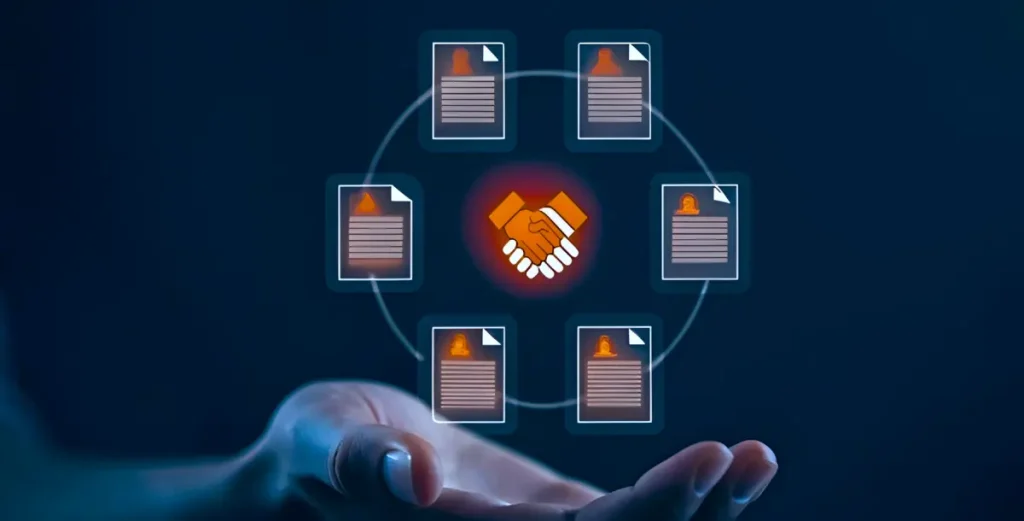
A smart contract is a self-executing digital agreement stored on a blockchain that automatically performs predefined actions when specific conditions are met.
Instead of relying on intermediaries, it uses code to verify, execute, and enforce the terms of an agreement. This concept is often summarized by the phrase “code is law,” meaning the programmed rules determine how the contract operates.
It turns business rules into code that executes itself. Instead of sending emails, raising tickets, and checking spreadsheets, you define the “if/then” logic once, and the network enforces it consistently, 24/7.
Smart contracts are widely used to power decentralized applications (dApps), digital asset transactions, and automated business processes.
Key Properties of Smart Contracts:
Deterministic: Given the same inputs, every blockchain node produces the same result, ensuring consistent and predictable execution.
Transparent: The contract’s code and transaction history are publicly visible on the blockchain, allowing anyone to verify how it operates.
Immutable: Once deployed, a smart contract’s code cannot be changed, ensuring that its predefined rules remain permanent unless an upgrade mechanism was built into the contract.
Tamper-resistant: Protected by blockchain cryptography and network consensus, making unauthorized alteration of their code, state, or transaction records extremely difficult.
Distributed: Stored and executed across a decentralized network of blockchain nodes rather than on a single server. This removes single points of failure and improves resilience and availability.
Composable: Smart contracts can interact with one another, allowing developers to combine different blockchain applications into more powerful solutions.
Example: A smart contract can hold payment in escrow until a trusted delivery oracle confirms an item has arrived. If delivery isn’t confirmed within seven days, it can automatically refund the buyer according to its predefined rules.
How does a Smart Contract work?
A smart contract follows a predefined set of rules written in code. Once deployed on a blockchain, it executes automatically when its specified conditions are met, without requiring intermediaries or manual intervention. Because the contract is stored on a decentralized network, every participating node verifies the transaction to ensure the outcome is consistent and trustworthy.
Smart Contract Lifecycle:
1. Conditions are written in code:
Developers define the contract’s rules and logic using programming languages such as Solidity (commonly used for Ethereum).
2. The contract is deployed to a blockchain:
After testing, the smart contract is published on a blockchain, where its code becomes immutable, meaning it cannot be easily altered after deployment.
3. A user initiates a transaction:
A user interacts with the smart contract by sending a transaction, such as transferring cryptocurrency or calling one of the contract’s functions.
4. The blockchain network validates the transaction:
Nodes on the decentralized blockchain verify the transaction and ensure it complies with the contract’s predefined rules.
5. The conditions are evaluated:
If the required conditions are satisfied, the smart contract proceeds with execution. Otherwise, the transaction is rejected or no action is taken.
6. The contract executes automatically:
The contract performs the programmed actions, such as transferring digital assets, updating records, or triggering another smart contract. Executing these operations typically requires users to pay a small gas fee, which compensates the network for processing the transaction.
7. The results are permanently recorded:
Once executed, the transaction and its outcome are permanently stored on the blockchain, creating a transparent and tamper-resistant record.
What Are Blockchain Oracles?
By design, smart contracts cannot directly access off-chain data, such as weather reports, stock prices, or shipment status. To bridge this gap, they rely on blockchain oracles—trusted services that securely deliver real-world information to the blockchain.
For example, a smart contract that releases payment only after a package is delivered depends on a delivery oracle to confirm the shipment status. Once the oracle provides the required data, the smart contract can automatically execute according to its predefined rules.
Smart Contract Applications and Common Use Cases
Smart contracts are used across a wide range of industries to automate processes, reduce manual work, and improve transparency. Some of the most common applications include:
| Industry | Common Use Cases |
|---|---|
| Finance (DeFi) | Lending and borrowing platforms, stablecoins, decentralized exchanges (DEXs), and automated insurance claims. |
| Banking | Mortgage processing, loan approvals, escrow services, and cross-border payments. |
| Supply Chain | Shipment tracking, inventory management, product authenticity verification, and automated supplier payments. |
| Healthcare | Secure medical record sharing, patient consent management, and insurance claim processing. |
| Digital Identity | Identity verification, access control, and decentralized identity (DID) management. |
| Real Estate | Property transfers, rental agreements, and automated escrow payments. |
| NFTs & Gaming | NFT creation and ownership, royalty distribution, and management of in-game digital assets. |
| Governance | Decentralized Autonomous Organization (DAO) voting, proposal management, and treasury governance. |
| Enterprise | Procurement, vendor agreements, supply contracts, and automated business workflows. |
By automating agreements and transactions, smart contracts help organizations reduce costs, improve efficiency, and minimize the need for intermediaries across many industries.
Programming Languages Used for Smart Contracts
Smart contracts are written using specialized programming languages, with the choice depending on the blockchain platform. Each language is designed to help developers build secure and reliable decentralized applications.
Here’s a few example:
Solidity (Ethereum): The most widely used smart contract language, designed specifically for Ethereum and other Ethereum Virtual Machine (EVM)-compatible blockchains such as BNB Chain, Polygon, and Avalanche.
Rust (Solana): A high-performance programming language known for speed and memory safety, making it well suited for Solana’s high-throughput blockchain.
Plutus (Cardano): A functional programming language based on Haskell that emphasizes security, correctness, and formal verification.
Michelson (Tezos): A stack-based language designed to support formal verification, helping developers create highly secure smart contracts on Tezos.
The programming language you choose typically depends on the blockchain ecosystem you plan to build on, as each platform supports its own development tools and execution environment.
Blockchain Platforms That Support Smart Contracts
Many blockchain networks support smart contracts, each offering different capabilities, performance, and ecosystems. Some of the most notable platforms include:
Ethereum: The most widely used smart contract platform, known for its large developer community and extensive decentralized application (dApp) ecosystem.
Bitcoin: Supports limited smart contract functionality through its scripting language, with more advanced capabilities enabled by solutions such as the Lightning Network and sidechains.
Cardano: Focuses on security and scalability, using the Plutus programming language for smart contract development.
Solana: Designed for high-speed, low-cost transactions, making it popular for DeFi, NFTs, and blockchain gaming.
Tron: Offers fast transaction processing and low fees, with a strong focus on digital content, entertainment, and decentralized applications.
Avalanche: A high-performance blockchain that supports Ethereum-compatible smart contracts while offering fast transaction finality.
Tezos: Emphasizes security and on-chain governance, allowing the network to evolve through community-approved upgrades.
BNB Chain: An Ethereum-compatible blockchain known for low transaction fees and a large ecosystem of decentralized applications.
Polygon: A Layer 2 scaling solution for Ethereum that enables faster transactions and lower costs while maintaining compatibility with Ethereum smart contracts.
Advantages and Benefits
Smart contracts automate agreements, reducing the need for intermediaries and minimizing human error. They execute transactions quickly and transparently once predefined conditions are met, improving efficiency and trust between parties. Because they run on blockchain networks, completed transactions are secure, tamper-resistant, and permanently recorded. These benefits make smart contracts a cost-effective solution for many business and financial applications.
- Automation
- Transparency
- Security
- Lower costs
- Faster settlements
- Accuracy
- No intermediaries
- Global accessibility
Limitations and Challenges
Despite their advantages, smart contracts have several limitations. Once deployed, they are generally immutable, making bugs or coding errors difficult and costly to fix. They also rely on blockchain oracles to access real-world data, introducing potential security and reliability risks if the oracle is compromised. In addition, network congestion, transaction (gas) fees, and evolving legal and regulatory frameworks can affect their adoption and practical use.
- Bugs risk
- Difficult to modify
- Oracle dependency
- Scalability
- Gas fees
- Legal uncertainty
- Poorly written code
Smart Contract vs Smart Legal Contract
These terms often used interchangeably, but they solve different problems. One is code that executes autonomously; the other is a legal agreement whose terms may be represented or enforced by code.
A smart contract is a self-executing program/ software that automatically performs actions when predefined conditions are met on a blockchain.
In contrast, a smart legal contract is a legally enforceable agreement that incorporates smart contract technology to automate certain obligations while remaining subject to applicable laws and legal frameworks.
Smart Contract vs Traditional Contracts
Traditional contracts are written documents that rely on manual execution and legal enforcement through courts or intermediaries.
Smart contracts, on the other hand, execute automatically based on code, enabling faster, more transparent, and tamper-resistant transactions without requiring third-party involvement.
Frequently Asked Questions (FAQs):
Are smart contracts legally binding?
Not necessarily. A smart contract is a piece of code that automates transactions, but whether it is legally enforceable depends on the applicable laws and the agreement between the parties involved.
Can smart contracts be changed?
In most cases, no. Once deployed on a blockchain, smart contracts are generally immutable, although developers can design upgradeable contracts or deploy a new version if changes are needed.
Are smart contracts secure?
Smart contracts are designed to be secure because they run on blockchain networks. However, coding errors, vulnerabilities, or compromised blockchain oracles can still expose them to security risks.
Who created the concept of smart contracts?
The concept of smart contracts was first proposed by computer scientist Nick Szabo in 1994, years before blockchain technology became widely available.
How to create a smart contract?
To create a smart contract, developers write the contract’s logic using a programming language such as Solidity, test it on a blockchain testnet, and then deploy it to a blockchain like Ethereum. Once deployed, the contract can execute automatically when its predefined conditions are met.
Can Bitcoin use smart contracts?
Yes, but with limitations. Bitcoin supports basic scripting for simple smart contracts, while more advanced functionality is available through Layer 2 solutions and sidechains.
What is an oracle in blockchain?
A blockchain oracle is a service that provides smart contracts with external data, such as weather conditions, asset prices, or shipment status. This enables smart contracts to respond to real-world events that are not available on the blockchain itself.
What is "gas" and gas fees?
Gas is the unit used to measure the computational work required to execute a transaction or smart contract on a blockchain. Users set a gas limit (the maximum amount of gas the transaction can consume) and pay a gas fee to compensate validators for processing the transaction.
Gas fees also help prevent network spam and allocate limited block space efficiently. If a transaction runs out of gas, it fails (reverts), but the gas used up to that point is generally not refunded.
What is the Ethereum Virtual Machine (EVM)?
The Ethereum Virtual Machine (EVM) is the decentralized execution environment that runs and processes smart contracts on the Ethereum blockchain. It ensures every node executes smart contract code in the same way, producing consistent and deterministic results across the network.
Many other blockchains, such as BNB Chain, Polygon, and Avalanche, are EVM-compatible, allowing developers to deploy Ethereum smart contracts with minimal modifications.
Atomic swaps
Atomic swaps are blockchain transactions that allow two parties to exchange cryptocurrencies directly without relying on a centralized exchange or intermediary. Smart contracts ensure that either both sides complete the trade successfully or the transaction is cancelled, preventing either party from losing funds.
DAO (Decentralized Autonomous Organization)
A Decentralized Autonomous Organization (DAO) is a blockchain-based organization governed by smart contracts instead of a central authority. Members typically vote on proposals using governance tokens, with decisions executed automatically according to predefined rules.
Application Logic Contracts (ALCs)
Application Logic Contracts (ALCs) are smart contracts that contain the business logic of a decentralized application (dApp). They define how the application processes transactions, enforces rules, and interacts with users or other smart contracts on the blockchain.
What is Etherscan?
Etherscan is a blockchain explorer for the Ethereum network that allows users to view and verify transactions, wallet addresses, smart contracts, token transfers, and block information. It also lets developers inspect verified smart contract source code and monitor on-chain activity in real time.