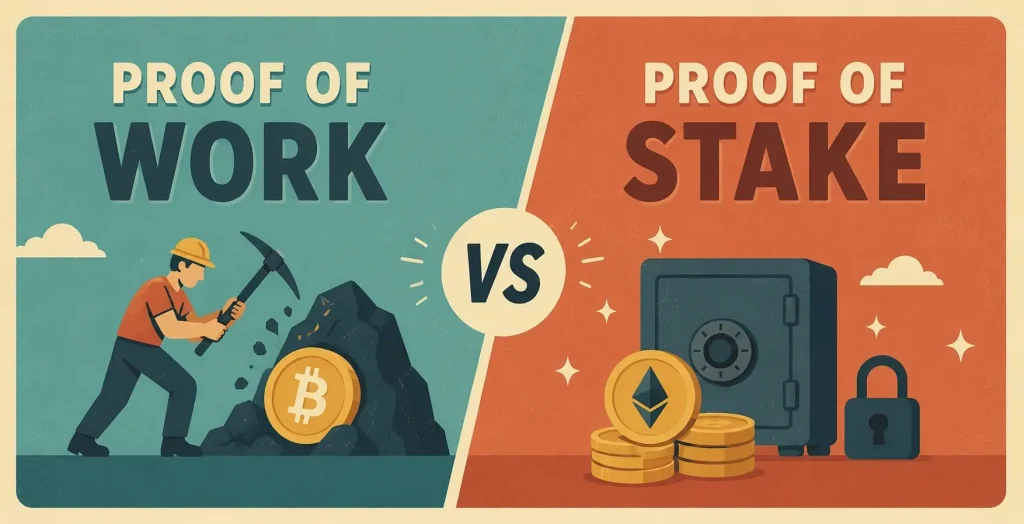
What is Proof of Work (PoW)?
Proof of Work (PoW) is a blockchain consensus mechanism that secures a network by requiring computers, known as miners, to solve complex cryptographic puzzles before new blocks can be added to the blockchain.
It was first introduced by Bitcoin to enable decentralized consensus without relying on a central authority. The first miner to solve the puzzle earns the right to validate the block and receives cryptocurrency rewards along with transaction fees.
PoW is widely recognized for its strong security but requires significant computational power and energy due to the mining process.
What is Proof of Stake (PoS)?
Proof of Stake (PoS) is another blockchain consensus mechanism that secures a network by selecting validators to verify transactions and create new blocks based on the amount of cryptocurrency they stake.
Unlike Proof of Work, PoS does not require energy-intensive mining, making it a more energy-efficient alternative.
Ethereum transitioned from Proof of Work to Proof of Stake through The Merge in 2022 to improve scalability and significantly reduce energy consumption. In a PoS network, participants lock up (stake) their cryptocurrency to help secure the blockchain and earn staking rewards in return.
How Proof of Work Works:
In a Proof of Work (PoW) blockchain, miners compete to validate transactions and add new blocks to the blockchain by solving a complex mathematical puzzle. This process ensures that all transactions are verified, prevents double-spending, and keeps the network secure without relying on a central authority.
Proof of Work Lifecycle:
1. Users submit transactions:
Users initiate cryptocurrency transactions, which are broadcast to the blockchain network.
2. Transactions are grouped into a block
Pending transactions are collected and bundled into a candidate block by miners.
3. Miners compete to solve a cryptographic puzzle
Each miner repeatedly performs hashing, the process of converting block data into a fixed-length cryptographic value called a hash, while trying different values until a valid hash is found.
4. The first miner finds the correct hash
The miner that discovers a hash meeting the network’s difficulty requirement wins the right to propose the new block.
5. Other nodes verify the solution
Network nodes quickly verify that the block and its hash are valid before accepting it.
6. The block is added to the blockchain
Once validated, the new block is permanently linked to the existing blockchain and shared across the network.
7. The miner receives rewards
The successful miner earns a block reward (newly minted cryptocurrency, where applicable) along with the transaction fees included in the block.
Key Concepts:
- Hash: A unique string of letters and numbers created from data. Even a tiny change to the original data will generate a completely different hash, making it easy to detect tampering.
- Hashing: The process of converting data into a unique hash using a cryptographic hash function. In PoW, miners perform hashing repeatedly to find a valid block hash.
- Hash Rate: The total computational power dedicated to mining on a PoW blockchain. A higher hash rate generally improves network security by making it more difficult for attackers to manipulate the blockchain.
How Proof of Stake Works:
In a Proof of Stake (PoS) blockchain, participants help secure the network by staking their cryptocurrency instead of using computing power to mine blocks. The blockchain protocol selects validators to verify transactions and create new blocks, making PoS a more energy-efficient alternative to Proof of Work.
Proof of Stake Lifecycle:
1. Users stake cryptocurrency:
Participants lock up a certain amount of cryptocurrency as collateral to help secure the network.
2. They become validators or join a validator pool
Users who meet the network’s staking requirements can become validators, while others may delegate their stake to a validator pool.
3. The protocol selects a validator
Each miner repeatedly performs hashing, the process of converting block data into a fixed-length cryptographic value called a hash, while trying different values until a valid hash is found.
4. The validator proposes or validates the next block
The selected validator verifies pending transactions and creates a new block.
5. Other validators verify the block
Other validators confirm that the proposed block follows the network’s rules before approving it.
6. The block is added to the blockchain
Once consensus is reached, the validated block is permanently added to the blockchain.
7. Validators earn staking rewards
Validators receive staking rewards and transaction fees for helping secure the network and maintaining consensus.
Validator Roles in Proof of Stake
Validators are responsible for verifying transactions, proposing new blocks, and helping the network reach consensus. To encourage honest behavior, many Proof of Stake blockchains use slashing, a mechanism that penalizes validators who act maliciously or repeatedly fail to perform their duties by reducing a portion of their staked cryptocurrency.
Proof of Work vs Proof of Stake:
What's the differences?
| Feature | Proof of Work (PoW) | Proof of Stake (PoS) |
|---|---|---|
| Consensus Mechanism | Miners solve cryptographic puzzles to validate blocks. | Validators stake cryptocurrency to validate blocks. |
| Participants | Miners | Validators |
| Hardware Requirements | Specialized mining hardware (ASICs or GPUs). | Standard computer or server with staked cryptocurrency. |
| Energy Consumption | High due to continuous mining. | Low since no mining is required. |
| Security Model | Secured by computational power and mining difficulty. | Secured by staked cryptocurrency and validator incentives. |
| Speed | Generally slower block creation and confirmation. | Faster block validation and transaction finality. |
| Transaction Throughput | Lower transactions per second (TPS). | Higher TPS on many PoS blockchains. |
| Decentralization | Highly decentralized but mining can concentrate in large mining pools. | Can be decentralized, though large stakeholders may have greater influence. |
| Operating Costs | High electricity, hardware, and maintenance costs. | Lower operating costs with minimal hardware requirements. |
| Rewards | Block rewards and transaction fees for miners. | Staking rewards and transaction fees for validators. |
| Environmental Impact | Higher carbon footprint due to energy-intensive mining. | More environmentally friendly with significantly lower energy usage. |
| Attack Resistance | Requires enormous computing power to perform a 51% attack. | Requires controlling a majority of the staked cryptocurrency, making attacks economically expensive. |
| Examples | Bitcoin, Litecoin, Dogecoin, Monero | Ethereum, Cardano, Solana, Avalanche, BNB Chain, Polygon, Tron, Tezos |
Simpler Analogy:
Proof of Work (PoW) rewards participants based on their computing power rather than the amount of cryptocurrency they own. Miners invest in specialized hardware and consume significant electricity to solve complex cryptographic puzzles, earning block rewards and transaction fees when successful.
By contrast, Proof of Stake (PoS) rewards participants based on the cryptocurrency they stake. Similar to earning interest in a savings account, users lock up their coins to help secure the network and receive staking rewards without requiring energy-intensive mining.
Advantages of Proof of Work
Proof of Work is widely regarded as one of the most secure blockchain consensus mechanisms because altering the blockchain requires enormous computational power. It has been battle-tested by Bitcoin for more than a decade, demonstrating its reliability and resilience. PoW is also highly decentralized, allowing anyone with the required mining hardware to participate in securing the network. Its high computational requirements make attacks, such as a 51% attack, extremely difficult and expensive to carry out.
Disadvantages of Proof of Work
One of the biggest drawbacks of Proof of Work is its high energy consumption, as miners continuously run powerful hardware to solve cryptographic puzzles. Specialized mining equipment, such as Application-Specific Integrated Circuits (ASICs), along with electricity and infrastructure costs, create a high barrier to entry for new participants. In addition, large-scale mining farms can concentrate mining power, raising concerns about centralization. Compared with many Proof of Stake blockchains, PoW networks also tend to have slower transaction processing and lower scalability.
Advantages of Proof of Stake
Proof of Stake is significantly more energy-efficient than Proof of Work because it eliminates the need for energy-intensive mining. It offers faster transaction finality, lower hardware requirements, and allows more users to participate through staking or validator pools. Many PoS blockchains are also designed with better scalability, enabling higher transaction throughput and lower transaction fees.
Disadvantages of Proof of Stake
Proof of Stake may lead to wealth concentration, as participants with larger stakes can have greater influence over block validation and rewards. Validators also face the risk of slashing, where a portion of their staked assets can be forfeited for malicious behavior or protocol violations. Additionally, staked assets may be locked for a certain period, reducing liquidity, and PoS has a shorter real-world track record than the battle-tested Proof of Work consensus mechanism.
Which is better: Proof of Work or Proof of Stake?
Neither Proof of Work (PoW) nor Proof of Stake (PoS) is universally better, as each is designed with different priorities. PoW emphasizes security, decentralization, and proven reliability, making it well suited for networks like Bitcoin.
In contrast, PoS focuses on energy efficiency, scalability, and faster transaction processing, making it a popular choice for modern blockchain platforms. Ultimately, the best consensus mechanism depends on the blockchain’s goals, performance requirements, and intended use cases.
FAQs and Glossary
What is mining?
Mining is the process used in Proof of Work (PoW) blockchains to validate transactions and add new blocks. Miners use specialized computers to solve cryptographic puzzles and earn block rewards plus transaction fees.
Explore ChainUp’s Crypto Mining Solution:
Interested in crypto mining infrastructure? Discover how ChainUp helps businesses build and manage secure, scalable, and high-performance crypto mining operations.
What is staking?
Staking is the process of locking cryptocurrency in a Proof of Stake (PoS) blockchain to help secure the network. In return, participants can earn staking rewards for validating transactions or supporting validators.
Explore ChainUp’s Institutional-Grade Bitcoin Restaking
Explore institutional-grade Bitcoin restaking infrastructure designed to help organizations earn protocol rewards while maintaining non-custodial asset control. Secure infrastructure enables institutions to participate in restaking without transferring custody of their Bitcoin to a third party.
What is a miner?
A miner is a participant in a PoW blockchain who uses computing power to solve cryptographic puzzles and validate new blocks. Successful miners receive block rewards and transaction fees.
What is a validator?
A validator is a participant in a PoS blockchain who stakes cryptocurrency to verify transactions and create new blocks. Validators earn rewards for helping maintain the security and integrity of the network.
What is a transaction hash (TXID)?
A Transaction Hash (TXID) is a unique identifier assigned to every blockchain transaction. It allows users to track and verify the status and details of a transaction on the blockchain.
What is a mining pool?
A mining pool is a group of miners who combine their computing power to increase their chances of mining a block. Any rewards earned are shared among participants based on their contributed hash power.
What is a validator pool?
A validator pool (or staking pool) allows multiple users to combine their staked cryptocurrency under a validator. Participants share the staking rewards without needing to operate their own validator node.
Mining Pool vs Validator Pool
A mining pool combines computing power for Proof of Work mining, while a validator pool combines staked cryptocurrency for Proof of Stake validation. Both allow participants to earn rewards together, but they support different consensus mechanisms.
What is slashing?
Slashing is a penalty mechanism used in many Proof of Stake blockchains. Validators who act maliciously or repeatedly violate network rules may lose a portion of their staked cryptocurrency.
What is a 51% attack?
A 51% attack occurs when a single entity gains control of more than half of a blockchain’s mining power or staked assets. This could allow the attacker to manipulate transactions, such as reversing their own payments, although achieving such control is extremely difficult on large blockchain networks.
Mining vs Minting (Forging)
Mining is used in Proof of Work, where miners solve cryptographic puzzles to create new blocks. Minting (sometimes called forging) is used in Proof of Stake, where validators create new blocks based on the cryptocurrency they have staked rather than computational power.
What is an ASIC Miner? How it works and why it matters
An Application-Specific Integrated Circuit (ASIC) miner is specialized hardware designed specifically for cryptocurrency mining. Compared with general-purpose CPUs or GPUs, ASIC miners deliver significantly higher hash rates and better energy efficiency, making them the preferred choice for mining cryptocurrencies such as Bitcoin.
Why did Ethereum switch from PoW to PoS?
Ethereum transitioned to Proof of Stake through The Merge in 2022 to reduce energy consumption, improve scalability, and support future network upgrades. The change reduced Ethereum’s energy usage by more than 99%.
Is PoS more secure than PoW?
Both consensus mechanisms are highly secure but rely on different security models. PoW is protected by computational power, while PoS is secured by staked cryptocurrency and validator incentives.
Can PoS replace PoW?
Not entirely. While many newer blockchains adopt PoS for its efficiency and scalability, PoW remains the preferred consensus mechanism for networks that prioritize proven security and decentralization, such as Bitcoin.