

Key Takeaways
- Solves Four Concrete Bottlenecks: Decentralized AI (DeAI) is not just a speculative theory—it directly mitigates structural GPU supply scarcity, concentrated model ownership, unverifiable “black-box” outputs, and restricted access to high-quality training data.
- Built as a Three-Layer Architecture: The DeAI stack comprises an Infrastructure Layer (compute, storage, and privacy), a Middleware Layer (agent identity and coordination), and an Application Layer (agentic finance and automated payments).
- Live Infrastructure Operating at Scale: Decentralized GPU compute markets and distributed data networks are processing massive production workloads and generating verifiable protocol revenues today.
- Native Financial Rails for Autonomous Agents: AI agents cannot access legacy bank accounts. On-chain stablecoins and smart contract wallets enable seamless machine-to-machine micro-settlement, serving a global agentic commerce market projected to scale exponentially by 2030.
- Cryptographic Verification as a Prerequisite: As autonomous agents manage real capital and private data, DeAI provides mathematical proof of execution via zero-knowledge technology and secure hardware enclaves.
Decentralized AI is the direct solution to a pressing business bottleneck: a tiny handful of corporations now control the vast majority of the compute, models, and training data that frontier AI runs on. This hyper-concentration is becoming a massive operational risk for developers building on top of proprietary ecosystems. DeAI solves this by distributing core functions—compute, model training, data aggregation, and verification—across peer-to-peer networks instead of single-provider data centers.
Why Centralized AI Hits Structural Limits

Centralized artificial intelligence isn’t hitting a wall because of poor execution; it is encountering physical and structural limitations that more capital and better code cannot fully resolve.
- Computers are scarce and getting more expensive. GPU infrastructure spend is projected to grow from $10 billion in 2025 to $77 billion by 2035, and data center GPUs have been sold out for months at a stretch. The decentralized compute market is projected to expand from $9 billion in 2024 to $22 billion by 2035, growth that only holds if the shortage is structural rather than cyclical.
- Control is concentrated in a handful of companies. The most widely used AI models today are each owned and operated by a small number of private firms, and most AI policy assumes that only a few entities can ever aggregate enough compute to train frontier systems.
- Outputs are largely unverifiable. Users have no way to confirm which model actually ran, whether the computation executed correctly, or whether sensitive data leaked in the process. That’s tolerable for a chatbot. It’s not acceptable once AI is handling loans, healthcare decisions, or an autonomous wallet.
- Training data is getting harder to source. Privacy regulations and rate limits increasingly choke off centralized data collection at the source, pushing developers toward distributed, incentive-based data networks instead.
How the Decentralized AI Stack Is Layered
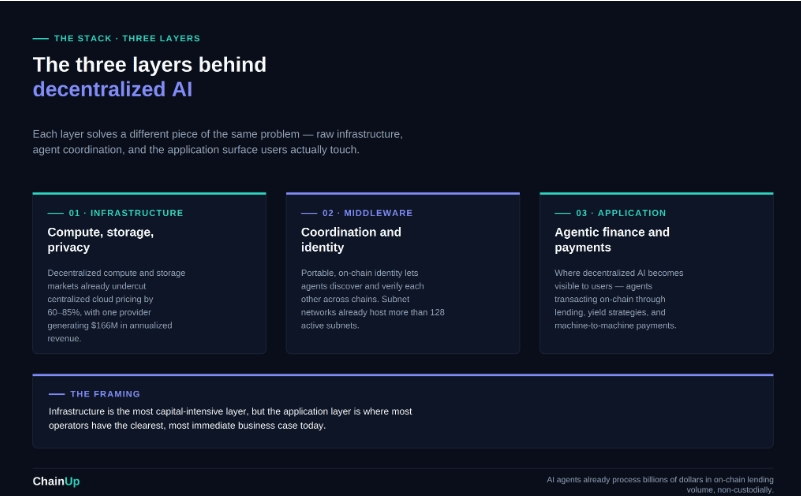
Decentralized AI isn’t just a single technology. It’s a stack, and each layer solves a different piece of the four problems above.
1. The Infrastructure Layer
This is the most capital-intensive layer of the ecosystem: the raw compute, storage, training, and privacy primitives that the entire stack relies upon. Compute marketplaces are already seeing explosive network activity:
- Akash Network: Operating as a highly efficient reverse-auction marketplace where providers compete for workloads, new active lease signings surged 27% quarter-on-quarter in early 2026 to over 43,500 leases. Simultaneously, its inference services process nearly 120 billion tokens monthly at a 60% to 85% discount compared to mainstream cloud providers.
- Aethir & io.net: Leading GPU aggregation networks have scaled up massively, with Aethir onboarding massive clusters of enterprise-grade chips to power AI workloads through its v2 mainnet. Top decentralized compute providers are now generating over $160 million in annualized revenue while delivering billions of compute hours.
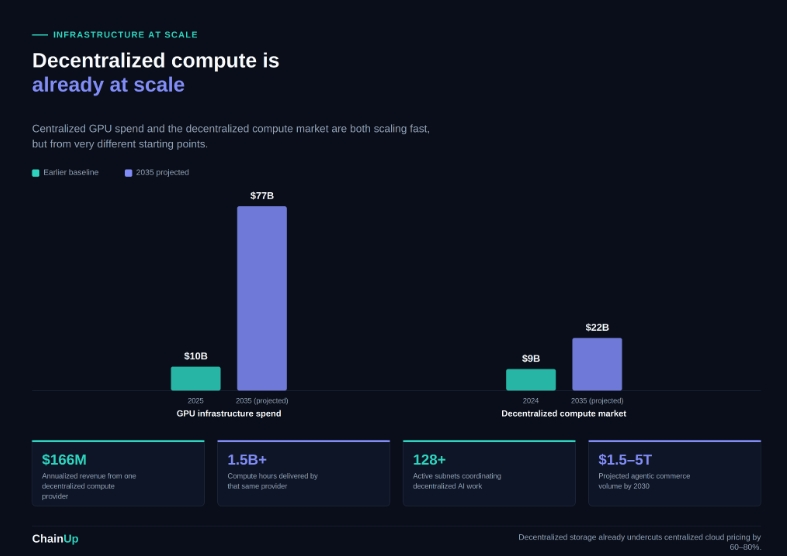
Storage tells a similar story. Decentralized storage networks routinely undercut centralized cloud pricing by 60% to 80%, with some offering storage under $1 per terabyte per month against roughly $30 per terabyte per month for centralized alternatives, a meaningful advantage as data center hard drive capacity reportedly sells out years in advance.
2. The Middleware Layer
As autonomous agents multiply, coordination becomes the new bottleneck: how agents discover one another, verify identities, and transact securely without human intervention.
Emerging Web3 standards replace fragile, centralized API keys with portable, on-chain agent identities and reputation metrics that travel fluidly across multiple networks. Subnet-based ecosystems—most notably Bittensor (TAO)—allow independent global operators to run specialized machine learning models and earn incentives based entirely on the verified utility of their outputs. The leading compute and reasoning subnets within this category are already generating millions in annualized protocol revenues.
3. The Application and Services Layer
This is where decentralized AI becomes visible to end users, mainly through two use cases: agentic finance and agentic payments.
What AI Agents Are Already Doing On-Chain
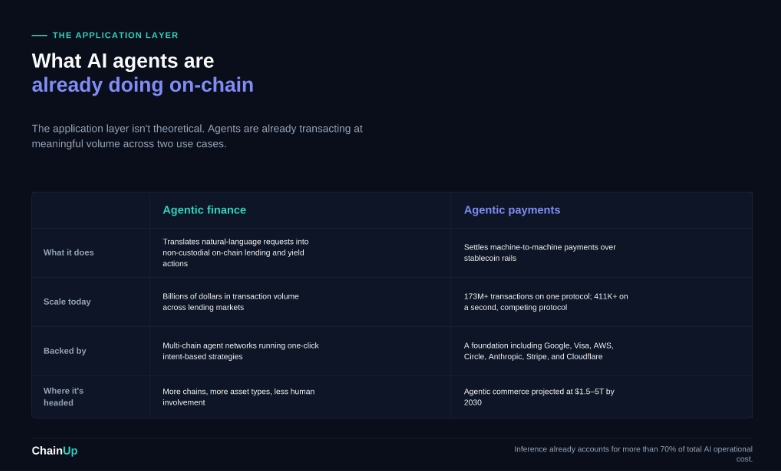
The application layer isn’t theoretical. AI agents are already executing financial transactions and settling payments at meaningful volume.
- Agentic finance. AI agents that translate natural-language requests into on-chain actions have already processed billions of dollars in transaction volume across lending markets, running non-custodially rather than through a centralized intermediary. Other agent networks now operate dozens of specialized agents that turn intents like “generate yield on this holding” into one-click strategies across multiple chains.
- Agentic payments. Stablecoin-based payment protocols built specifically for machine-to-machine transactions had processed more than 173 million transactions on major blockchains as of May 2026, with a foundation backing the standard that includes Google, Visa, AWS, Circle, Anthropic, Stripe, and Cloudflare. A second, competing payments protocol has logged over 411,000 transactions since launch. Most of this volume is recurring, pay-as-you-go usage: API calls, AI inference billing, and agentic commerce, not one-off experiments.
Goldman Sachs has forecast that agentic AI will drive token consumption up 24-fold by 2030, reaching 120 trillion tokens a month, with inference alone already accounting for more than 70% of total AI operational cost.
Overall, agentic commerce is projected to reach $1.5 to $5 trillion by 2030. The constraint is that most systems still don’t let an AI agent hold and move funds independently, which is exactly the gap blockchain-based wallet infrastructure is built to close.
Why Verification and Privacy Are Becoming Non-Negotiable for the AI Economy
The same unverifiable-output problem that limits centralized AI does not disappear just because a model runs on decentralized compute. Ordinary users cannot confirm whether their data was processed privately, whether a computation was executed correctly, or whether the model claimed to be the one actually used.
Privacy-preserving computation—where models run on encrypted data without ever decrypting it—and verifiable inference—where every output carries a cryptographic proof it was not tampered with—are increasingly treated as prerequisites rather than premium add-ons.
For any business letting AI touch financial transactions, healthcare data, or autonomous decision-making, cryptographic verification is the trust layer. It is what determines whether regulators, auditors, and counterparties will actually accept an AI agent’s execution output as authoritative.
Why Web3 Infrastructure Is the Missing Piece for AI Agents
For builders evaluating this space, the honest picture is that decentralized AI is real and generating measurable revenue, but it remains early. While model training gets the headline attention, training frontier models on-chain is not where the immediate business value sits today.
Instead, the most urgent frontier for Decentralized AI lies in Web3 financial and connectivity infrastructure.
An AI agent cannot open a traditional bank account, complete manual KYC forms, or sign credit card agreements. For AI agents to operate autonomously, they require native Web3 protocols built specifically for machine-to-machine interaction:
- Machine Payment Standards (e.g., the x402 Protocol): By operationalizing the unused HTTP <402 Payment Required> standard, protocols like x402 enable AI agents to evaluate resource costs, execute instant micro-payments in stablecoins, and access paid APIs or compute resources programmaticly—all without human intervention.
- Non-Custodial Agentic Wallets: Software agents require dedicated key architecture that lets them hold operational budgets, execute trades, and manage yield positions while remaining bounded by strict programmatic policy limits (session caps, transaction limits, and key isolation).
- On-Chain Settlement & Connectivity: Decentralized networks provide the 24/7, frictionless settlement rails that allow agents to transact across borders in seconds at near-zero gas costs.
Without robust Web3 infrastructure bridging the AI runtime to decentralized networks, an autonomous agent remains a “read-only” software tool—capable of recommending actions, but powerless to execute them.
Building the Rails Decentralized AI Agents Still Need
As decentralized AI transitions from research experiments to production-grade financial applications, the resilience of the underlying infrastructure becomes the defining factor for success. Building autonomous systems requires stable execution environments, secure key management architectures, and seamless connectivity to global liquid markets.
As a global leader in blockchain technology solutions, ChainUp provides end-to-end digital asset infrastructure designed to power modern Web3 enterprises and emerging autonomous ventures. From institutional-grade wallet architectures and exchange software to advanced liquidity solutions and secure network access, ChainUp equips businesses with the foundational, compliant tools needed to deploy, scale, and secure next-generation decentralized applications.