
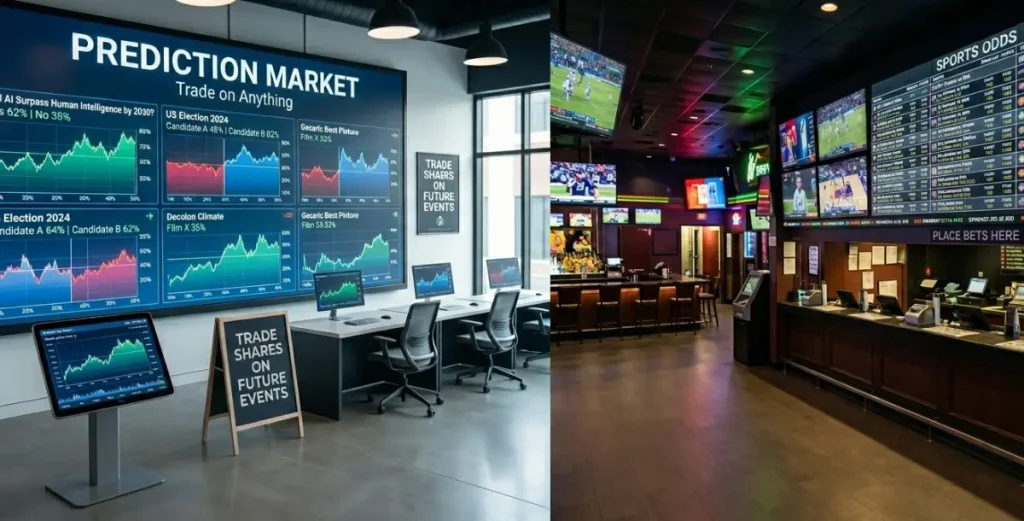
Decentralized prediction markets gained serious momentum in 2025. Total trading volume across major platforms surpassed $44 billion, while open interest reportedly grew from roughly $3.3 billion to nearly $13 billion within the same year.
By February 2026, Polymarket alone was clearing more than $7 billion in monthly volume, showing how quickly blockchain-based forecasting platforms have moved from niche crypto products to high-volume trading venues.
The growth of crypto prediction markets signals a structural shift from traditional sportsbooks—which rely on centralized settlement and bookmaker-set odds—toward blockchain-based architectures that utilize event contracts to price uncertainty through collective real-time probability.
How Traditional Sportsbooks Work
Traditional sportsbooks are the institutions most people associate with wagering. From the user’s perspective, the experience is simple. You choose an event, pick an outcome, stake an amount, and receive a payout based on the odds offered.
Behind that simplicity lies a carefully engineered system designed to guarantee the house a consistent margin. Sportsbooks employ teams of oddsmakers and quantitative analysts who set opening lines based on historical data, team statistics, and proprietary models.
These lines are adjusted continuously based on incoming bets, sharp money, and breaking news. The sportsbook always sets the price and embeds its profit margin, commonly called the “vig” or “juice,” directly into those odds. Common formats include:
- Moneyline bets: Betting on which team or player will win. For example, Lakers -150 means you risk $150 to win $100, while Celtics +130 means you risk $100 to win $130.
- Point spreads: Betting on whether a team wins by, or loses within, a certain margin. For example, Chiefs -6.5 means they must win by at least 7 points for the bet to win.
- Totals or over/under: Betting on whether the combined score will be above or below a set number. For example, Over 218.5 in an NBA game means the total score must reach 219 or higher.
- Parlays: Combining multiple bets into one ticket. The payout is higher, but every leg must win.
A sportsbook builds its margin into the odds. On a typical moneyline or spread market, both sides might be priced at -110, meaning a bettor must risk $110 to win $100. When both sides are converted into implied probability, the total exceeds 100%. That excess is the sportsbook’s built-in edge, often around 4% to 5%.
Sportsbooks also manage risk by controlling customer activity. Bettors who consistently win may face lower limits, account restrictions or delayed withdrawals. This is part of the traditional bookmaker
How Prediction Markets Work
Prediction markets work differently from sportsbooks because prices are set by traders, not bookmakers. Users buy and sell contracts tied to real-world outcomes, and the market price becomes the implied probability of that event.
Key Structural Differences
- Pricing Mechanism: In traditional sportsbooks, odds are centrally determined by bookmakers with built-in house margins. In contrast, prediction markets utilize event contracts where prices are set by open peer-to-peer trading, reflecting the real-time implied probability of an outcome based on market conviction.
- Participant Interaction: Traditional bettors wager directly against the house (the operator), which may impose limits or restrictions on successful users. Prediction market participants trade outcome contracts against the broader market, allowing them to enter or exit positions freely based on available liquidity.
- Settlement and Transparency: While traditional sportsbooks control the settlement process manually, prediction markets leverage blockchain infrastructure to automate settlement via smart contracts and oracles. This ensures that payouts are governed by transparent code rather than a centralized entity.
For example, a contract on “Team A wins the championship” may settle at $1.00 if Team A wins and $0 if it loses. If that contract trades at $0.62, the market is pricing the outcome at roughly a 62% probability.
The key difference is the source of truth. Sportsbooks price risk to protect their margin. Prediction markets let participants trade their view of probability directly, making them useful not only for wagering, but also for forecasting public expectations in real time.
Key Differences Between the Two Models
| Factor | Traditional Sportsbook | Prediction Market |
| Price Setting | Bookmaker / oddsmakers | Open crowd trading |
| Built-in Margin | ~4 to 5% embedded in odds | Explicit transparent fee |
| Market Coverage | Primarily sports | Sports, politics, economics, crypto, and more |
| Settlement | Centralized / operator discretion | Smart contract / oracle-driven |
| Transparency | Opaque | Fully on-chain and publicly auditable |
| Winning Players | Restricted or banned | No limits, but high pro competition |
| Regulatory Frame | State gambling license | CFTC derivatives framework (U.S.) |
| Global Access | Jurisdiction-restricted | Blockchain-native, globally accessible |
| Retail Return (2025 to 2026) | Median -5% | Median -8% |
Price Discovery and Odds Setting
Sportsbooks set odds internally. Prediction markets let users trade outcome contracts, so prices move based on market demand and collective information. This can make prices more responsive when new data enters the market.
The Vig vs. Transparent Fees
Sportsbooks build their margin into the odds, often through the vig. Prediction markets usually charge visible trading or settlement fees. The cost is clearer because users can see what they are paying instead of absorbing it through adjusted odds.
Market Coverage
Sportsbooks focus mainly on sports. Prediction markets can cover any verifiable event, including elections, interest rates, inflation data, crypto prices, technology launches and geopolitical developments.
Transparency and Settlement
Sportsbooks settle bets through centralised systems. Blockchain-based prediction markets can use smart contracts and oracles to settle outcomes automatically, with trades and payouts recorded on-chain.
Winning Player Tolerance
Sportsbooks may limit or restrict consistently profitable bettors. Prediction markets generally do not need to, because users trade against other market participants rather than against the platform itself.
Retail Risk
Prediction markets are more open, but that also means retail users may face professional traders and algorithmic market makers directly. Better access does not automatically mean better outcomes.
The Role of Blockchain Infrastructure In Prediction Markets
Blockchain is not just a technical layer for prediction markets. It changes how event-based markets are built, settled and trusted.
For sports betting, this matters because the traditional model relies heavily on centralised operators. The sportsbook sets the odds, holds user funds, applies limits and controls settlement. Blockchain-based prediction markets move more of that process into open infrastructure, where trades, liquidity, rules and payouts can be verified more transparently.
Key infrastructure advantages:
- Smart contract settlement – Funds can be locked in a smart contract and released automatically once the event outcome is verified. This reduces reliance on a central operator to process payouts.
- Transparent market activity – Trades, liquidity and settlement activity can be recorded on-chain, giving users more visibility than closed sportsbook systems.
- Global liquidity access – Blockchain markets can connect users through wallets and stablecoins, expanding the pool of participants beyond local betting accounts or banking rails.
- Decentralised market pricing – Prediction market prices come from user trading activity rather than bookmaker-set odds. This makes the market feel more open and less dependent on one central pricing authority.
- DeFi composability – Prediction market positions can potentially connect with lending, collateral, hedging or automated trading strategies, something traditional sportsbooks cannot easily support.
The key dependency is oracle infrastructure. Smart contracts cannot know the final score of a match on their own. They need trusted data feeds from oracle networks such as Chainlink, UMA or similar providers to verify outcomes and trigger settlement.
The Strategic Evolution of Prediction Markets
Prediction markets are transcending their origins in sports betting to become sophisticated financial infrastructure. By shifting the focus from simple wagering to high-fidelity data signaling, these platforms offer three distinct advantages for the modern digital economy:
- Institutional Data Signaling: Beyond sports, these markets provide real-time probability signals on mission-critical events such as Federal Reserve interest rate decisions, regulatory shifts, and geopolitical risks. For treasury teams and corporate strategists, this creates a “pricing of uncertainty” that traditional sportsbook lines cannot replicate.
- Regulatory Maturation: While sportsbooks are governed by gambling laws, leading prediction markets are increasingly aligned with event-based derivatives under oversight from bodies like the CFTC. This shift toward financial-market compliance—including robust KYC and transaction monitoring—builds the institutional credibility necessary for enterprise adoption.
- Technical Accessibility: The historical friction of blockchain mechanics (wallets and gas fees) is being replaced by polished, consumer-grade interfaces. Modern platforms now offer a user experience that mirrors financial trading apps, attracting a demographic of information-driven users who prioritize liquid entry and exit over traditional betting parlays.
Are Prediction Markets Replacing Sportsbooks?
Rather than direct substitutes, these two models are becoming complementary products. Estimates suggest revenue cannibalization is minimal (1% to 2%), as they serve different needs:
- Sportsbooks remain focused on consumer entertainment and recreational “house-backed” gambling.
- Prediction Markets serve as high-fidelity tools for information discovery, hedging, and professional trading.
The industry is moving toward a hybrid future. Leading operators are already adopting market-based mechanics and blockchain-based settlement. The architecture of event-based wagering is being rebuilt on transparent, efficient rails, defining a new era where “pricing the future” is as much about data as it is about sport.