

Key Takeaways
- Crypto card spending has expanded more than 15x since 2023 (reaching an ~$18B annualized run rate), signaling that end-user transaction demand is outpacing traditional payment processor readiness.
- Rather than requiring merchants to deploy new point-of-sale (POS) hardware, leading programs settle stablecoins over existing Visa and Mastercard networks—giving users instant access to over 175 million merchant endpoints.
- Recurring crypto payments (payroll, subscriptions, B2B invoicing) grew 18% year-over-year, anchored primarily by stablecoins settling on low-cost settlement layers.
- Frameworks such as the US GENIUS Act and EU MiCA have replaced regulatory ambiguity with enforceable compliance standards for stablecoin issuance, reserve backing, and payment processing.
Demand for crypto payments is growing faster than the infrastructure built to support it. Crypto card spend has grown more than 15 times since 2023, and platforms are leaning hard on that momentum.
Crypto super-apps and exchanges are turning community engagement into payment engines. Platforms like Crypto.com—with its 150M+ member CROFam community—channel user activity directly into everyday spend through tiered card rewards, cashback programs, and merchant campaigns.
For exchanges, custodians, and fintechs, understanding the payment rails capturing this liquidity is essential to maintaining market share.
Crypto Card And Payment Demand By The Numbers
Before mapping strategy, it helps to separate global market figures from what is happening specifically in the US, since the two tell slightly different parts of the same story.
| Global crypto payments market | |
| Metric | 2026 Figure |
| Global crypto payment retail volume (forecast) | Roughly $600 billion by year end |
| Merchants expected to accept crypto by year end | Over 25 million |
| Average value of a retail crypto payment | About $112 |
| Total stablecoin market cap | Roughly $300 billion to $323 billion |
| Recurring crypto payments (subscriptions, payroll) growth | About 18% year over year |
| US crypto payments market | |
| Metric | 2026 Figure |
| US merchants currently accepting crypto | Around 39% |
| Crypto card spend growth since 2023 | Over 15 times |
| Annualized crypto card spend run rate | Roughly $18 billion |
Read together, these numbers point to a market where consumer and merchant demand is real and growing quickly, and where the US specifically is still building out acceptance infrastructure to keep pace with card spend.
The clearest signal: people are paying, not just trading. Recurring crypto payments — subscriptions, payroll, business transfers — grew roughly 18% over the past year. Stablecoins are the asset behind most of that growth, since they let a payment settle in minutes without either side worrying about price swings. Much of that activity now sits in DeFi protocols and treasury tools rather than exchange balances, with businesses using stablecoins for supplier payments, payroll, and working capital rather than trading.
Consumer demand has kept climbing even as speculative token prices pulled back through parts of 2026 — a split that shows people are increasingly using crypto to pay rather than to trade. Monthly crypto card spend rose from roughly $100 million in early 2023 to about $1.5 billion by late 2025, an annualized run rate near $18 billion, holding steady through market pullbacks that would have curbed pure speculative activity.
How Stablecoins Power the Everyday Payments Shift
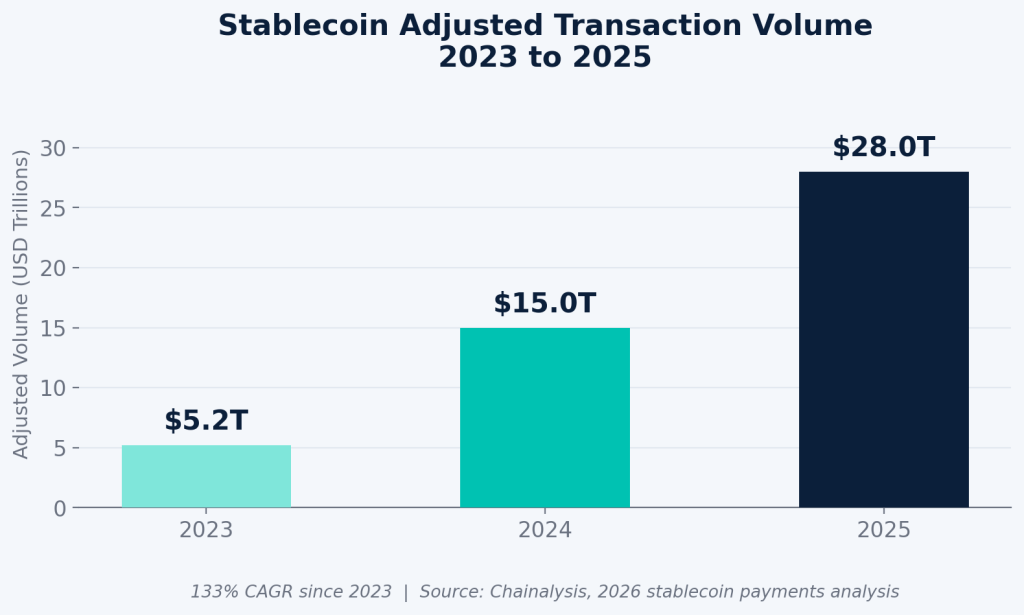
The clearest signal in the 2026 data is that crypto payments are being used more often for everyday transactions, not just held as a speculative bet.
Recurring crypto payments, covering subscriptions, payroll, and business transfers, grew by roughly 18% over the past year, and stablecoins are the asset behind most of that growth because they let a payment settle in minutes without either side worrying about price swings.
Much of that activity now sits in DeFi protocols and treasury tools rather than exchange balances, with businesses using stablecoins for supplier payments, payroll, and working capital rather than trading. Crypto custody providers have become the operational backbone of this shift, since institutions need audited, insured wallet infrastructure before they will hold any crypto asset, stablecoin or otherwise, at scale.
Regulatory Clarity: A Structured Pathway for Processors
Regulatory uncertainty was long cited as a primary barrier to crypto acceptance, and clearer rules have not so much removed that barrier as given the market a structured pathway through it.
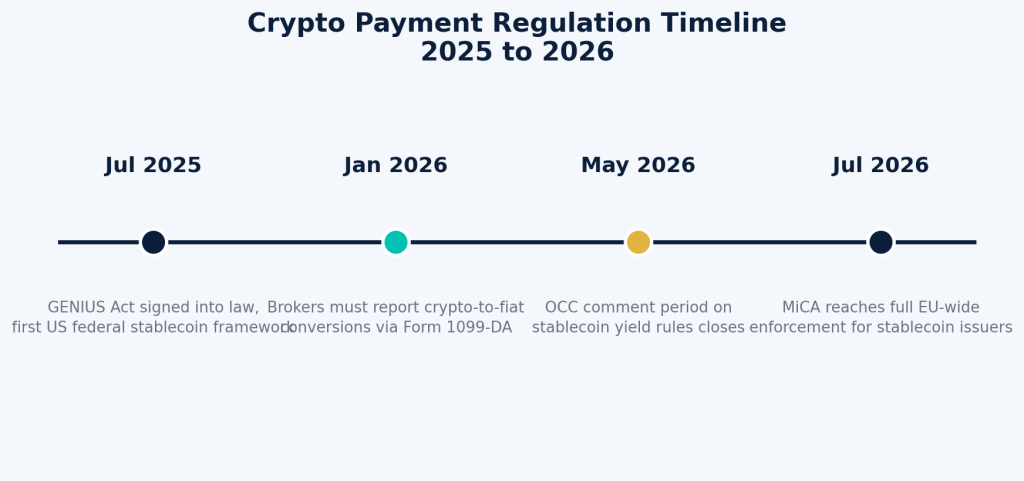
The GENIUS Act became law in July 2025, giving payment stablecoins a federal reserve and redemption framework in the US for the first time.
Starting January 2026, payment processors that convert crypto to fiat for merchants must report those conversions to the IRS, which brought crypto tax treatment closer to how card transactions are already handled.
MiCA’s full EU enforcement in July 2026 closed the equivalent gap in Europe, requiring e-money token issuers to hold full reserves at regulated institutions and publish monthly attestations.
Together, these frameworks give exchanges, custodians, and processors a defined set of rules to build against rather than a patchwork of open questions, which is what is letting card programs and merchant integrations scale with more confidence.
Processors And Rails Winning The Crypto Payments Race
Demand is outpacing supply on the processor side. Over 25 million merchants are expected to accept at least one form of cryptocurrency by the end of 2026, and crypto card spend has grown more than 15 times over the past three years, evidence that consumer appetite is running ahead of what most processors can support today.
A large share of that growth rides on rails that already exist. Most crypto cards today settle through the Visa or Mastercard network rather than a purpose-built crypto rail, and that is a feature, not a limitation, since it means a crypto card works at nearly any point of sale terminal already installed at any merchant worldwide. Bypassing that existing terminal footprint is not realistic for most vendors, so providers that plug stablecoin balances into Visa or Mastercard settlement are scaling faster than those asking merchants to install new hardware.
Beyond that, the providers pulling ahead share a few more traits, starting with cost. A merchant settling through crypto rails can cut processing costs to a fraction of typical card interchange fees, since stablecoin settlement removes several intermediaries that traditional card rails still charge for.
They also support multiple blockchains rather than one, pairing low-cost networks for everyday purchases with faster settlement layers for high-value transfers, and they build in blockchain analytics and sanctions screening so every transaction can be defended to regulators and banking partners.

Stablecoin Cards Are The Fastest Growing Bridge To Everyday Spend
Consumer demand for crypto payments has kept climbing even as speculative token prices pulled back through parts of 2026, a split that shows people are increasingly using crypto to pay rather than to trade.
While direct on-chain checkout is still a niche behavior, stablecoin-linked cards have quietly become the main way people spend crypto day to day, and the growth curve reflects genuine demand rather than a price-driven fad.
Monthly crypto card spend rose from roughly $100 million in early 2023 to about $1.5 billion by late 2025, an annualized run rate near $18 billion and more than 15 times growth in under three years, a pace that held steady through market pullbacks that would have curbed pure speculative activity.
Visa carries over 90% of that on-chain crypto card volume even though both Visa and Mastercard now support more than 130 crypto card programs between them. PayPal is taking a different path with its own PYUSD stablecoin, building a closed-loop network where it controls both the consumer wallet and the merchant relationship rather than riding existing card rails.
For merchants exploring white-label exchange and wallet builds, the card model matters because it lets a business capture stablecoin-funded spend without asking a single customer to change their checkout habits.
Regional Adoption Patterns Are Reshaping The Market
Adoption is no longer concentrated in one region or one use case.
- North America leads on infrastructure readiness, with most surveyed firms reporting their systems are ready to move stablecoins from pilot to production.
- Europe has the clearest rulebook following MiCA, and few respondents there still see regulation as a barrier.
- Latin America and parts of Asia are growing fastest in real-world usage, driven by remittances, gig payouts, and B2B trade corridors rather than trading activity.
Enterprise Treasury Navigating the Integration Gap
Institutional money is already moving into this space at a meaningful scale, even if day to day commercial use still lags.
Roughly 86% of surveyed firms report their infrastructure is ready for stablecoin adoption, and a Nasdaq-listed B2B crypto payments processor alone saw transaction volume jump from $39 million in 2020 to more than $2 billion in 2024, a rough proxy for how fast institutional volume is compounding across the sector.
Despite that build-out, most corporate treasurers have not moved from talk to action on the payments side. Recent PYMNTS Intelligence research found that the majority of CFOs surveyed would rather build a stablecoin strategy through their existing bank than through a crypto-native wallet or fintech intermediary, even when the bank option is slower to launch.
Federal Reserve research backs up that hesitation, showing that most stablecoin assets in circulation today are not moving through the real economy at all. Instead they sit idle in wallets or circulate within crypto markets rather than paying for goods, services, or payroll.
This gap between headline volume and actual commercial use is exactly why crypto custody providers that can plug into a bank’s existing risk and compliance stack, rather than replace it, are likely to win enterprise mandates first.
Concentration And De-Pegging Risks Still Need Watching
The market’s growth story comes with real structural risk that deserves equal billing. Ethereum hosts about 58.8% of total stablecoin supply and Tron accounts for roughly 31%, meaning close to 90% of all stablecoin value sits on just two networks.
USD-denominated tokens make up around 99% of stablecoin market value, and researchers have flagged roughly 600 de-pegging events across the past two years as evidence that reserve quality and redemption mechanics still vary widely between issuers.
Anyone evaluating a stablecoin partner for DeFi protocols or treasury use should weight issuer reserve composition and redemption history as heavily as brand recognition.
Cross-Border Payments And Remittances Remain The Clearest Use Case
Demand for faster cross-border payments is not theoretical, it already shows up in daily transaction data. Cross-border payment volume using stablecoins grew by roughly 32% year over year in 2025, and Latin America’s crypto transaction volume alone grew by around 22% over the same period, driven mostly by stablecoin use in e-commerce and remittances rather than trading.
Recent flow analysis shows that stablecoin corridors increasingly track real economic ties rather than pure speculative movement, with routes like US to Mexico standing out alongside a broader set of developed and emerging market pairs. That thesis is playing out in real deployments.
MoneyGram launched a stablecoin wallet in El Salvador as the first step in a wider Latin America rollout, while DoorDash announced it would offer stablecoin payments to simplify a three-sided marketplace spanning consumers, merchants, and delivery workers.
These are mainstream payment and logistics platforms choosing stablecoin rails because settlement lands in minutes instead of days, a gap that matters most for gig workers, suppliers, and remittance recipients who cannot absorb multi-day banking delays.
This is also where blockchain analytics tooling earns its keep, since corridor-level monitoring is what lets banking partners sign off on these routes in the first place.
What Comes After 2026
The next few years are likely to bring more new payment rail infrastructure than new price milestones.
Visa and Stripe’s Bridge subsidiary have already announced stablecoin-linked Visa cards expanding to more than 100 countries by the end of 2026, letting consumers spend stablecoins at any of Visa’s 175 million merchant acceptance points while merchants keep receiving ordinary fiat settlement.
Card issuers, processors, and banks are racing to build the middleware that connects stablecoin balances to those existing acceptance points, since that bridge infrastructure, not a new blockchain, is what will determine how fast mainstream spending shifts.
Separate research points to a demographic tailwind layered on top of that build-out, with an estimated $80 trillion to $100 trillion in wealth moving from Baby Boomers to Millennials and Gen Z over the coming decades, generations in which nearly half have already held or currently hold crypto.
Combine that wealth transfer with point-of-sale saturation, where accepting stablecoins becomes standard merchant infrastructure rather than a deliberate choice, and current growth curves suggest on-chain stablecoin transaction counts could match Visa and Mastercard’s off-chain volumes sometime between 2031 and 2039.
Businesses building agentic payment and machine-to-machine settlement capability now are positioning for that same shift, since programmable stablecoin rails are what will let software agents pay each other for data, compute, or API calls without a human invoicing step in between.
Launching Next-Generation Crypto Payment Programs
Businesses building or scaling payment products must plan around three core realities: compliance must be embedded from day one now that enforceable frameworks are live; card programs must meet users where they already spend rather than restricting them to crypto-native apps; and speed to market determines who captures active demand growth.
ChainUp’s White-Label Crypto Card Solution
Engineered around these exact market demands, ChainUp’s white-label crypto card infrastructure empowers operators to launch a fully branded program without stitching together fragmented vendors for custody, liquidity, and issuance.
- Global Utility & Instant Access: Users can load their cards instantly using USDT or USDC and spend anywhere worldwide—online, in-store, or at ATMs across over 180 countries—via global Visa and Mastercard networks, Apple Pay, and Google Pay.
- Optimized Economics: By pulling from a network of multiple card issuers, we keep transaction fees low and eliminate top-up fees entirely, protecting profit margins for your business while keeping costs low for your users.
- Built-In Regulatory Infrastructure: Compliance is built right into the platform from day one. The solution includes native KYC (Know Your Customer), KYB (Know Your Business), KYT (Know Your Transaction), and AML (Anti-Money Laundering) tools, saving you the headache of integrating third-party compliance vendors.
Scale Your Payment Product
Operating alongside ChainUp’s white-label exchange, wallet, and tokenization rails, our infrastructure enables crypto payments and cards to scale commercially with speed and security.
Ready to capture market share? Reach out to ChainUp to map your 2026 go-to-market strategy.