Key Takeaways
- Account Abstraction (AA) replaces traditional onboarding friction (seed phrases, gas token hurdles, and browser extensions) with one-tap social and passkey authentication, cutting customer acquisition costs.
- Turning wallets into programmable accounts unlocks new monetization streams, including promotional gas sponsorship, stablecoin fee settlement in USDC, and automated subscription billing.
- Since ERC-4337 launched, over 40 million smart accounts have been deployed across Ethereum and Layer 2 networks, with total ecosystem smart accounts exceeding 200 million globally.
- Pairing ERC-4337 for new signups with EIP-7702 for existing accounts lets platforms deploy institutional governance, session keys, and automated compliance without disrupting user habits.
Most people who try a crypto product never finish signing up. They hit a seed phrase, a gas fee they cannot pay, or a wallet extension they do not understand, and they leave.
Account abstraction fixes that at the root by turning wallet friction into a one-tap experience, which is the single reason smart accounts have become one of the fastest-growing pieces of Ethereum infrastructure.
Since ERC-4337 launched on Ethereum mainnet in March 2023, more than 40 million smart accounts have been deployed across Ethereum and Layer 2 networks, and industry estimates now put total smart wallets above 200 million as adoption compounds through 2026.
For businesses building on crypto custody infrastructure, that curve matters more than any spec sheet. It is the reason a first-time user can now sign up for your product the way they would sign up for any app, and it changes how you win, keep, and monetize customers.
What Account Abstraction Lets Your Users Do
Underneath the term is a switch from a rigid wallet to a programmable account. A traditional wallet, or Externally Owned Account, works like a safe with one irreplaceable key, so every action needs that key and a native token for gas.
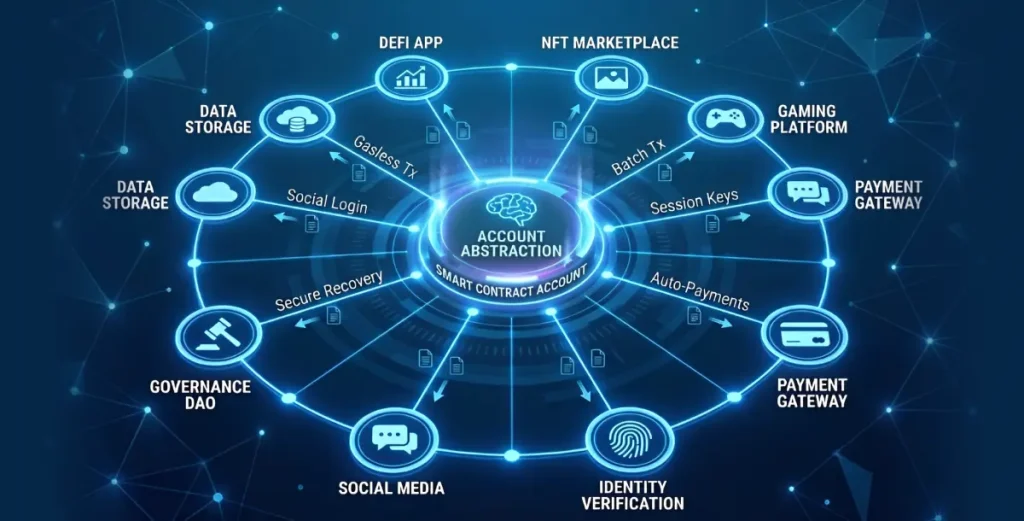
Account abstraction replaces it with a smart account that follows rules you set. In practice, that unlocks a specific set of capabilities you can build into your product.
- Let users sign in with an email, social login, or passkey, with no seed phrase to lose
- Sponsor gas fees as an acquisition cost, or let users pay them in a stablecoin like USDC
- Batch a multi-step action into a single approval instead of several signatures
- Add spending limits, guardians, and multi-signature rules for everyday safety
- Restore access through trusted contacts rather than a recovery phrase

How Account Abstraction Makes Exchanges More User Friendly
For exchange platforms specifically, account abstraction removes the friction that stalls both new traders and back-office operations. The same one-tap experience that helps a first-timer also cleans up how your own team manages funds.
- Onboarding. A new trader can open an account with a passkey and start trading in seconds, without buying a native token first.
- Gasless withdrawals. Sponsor or abstract the gas on self-custody withdrawals so users never get stuck needing ETH to move their own assets.
- Stablecoin fees. Let users cover network costs in USDC, which removes the last reason a customer has to leave your platform to buy gas.
- Operational control. Run your own treasury and hot wallet flows through smart accounts with multi-signature approvals and spending limits that mirror your internal sign-off chain.
This is where a white-label exchange build and account abstraction reinforce each other, since the same programmable account that smooths onboarding also tightens the controls your operations team relies on.
How ERC-4337 Works Without Changing Ethereum’s Core
The mechanism behind this shift is EIP-4337, a standard that adds account abstraction through smart contracts rather than a network-wide upgrade. Three pieces work together, similar to a hotel concierge desk sitting on top of existing infrastructure:
| Component | What It Does |
| UserOperation | The user’s signed intent, replacing a raw transaction |
| Bundler | Groups UserOperations and submits them on-chain |
| Paymaster | Decides who pays gas and in what currency |
This same architecture now works alongside EIP-7702, which lets existing wallets borrow smart account features without migrating to a new address.
Within the first week of the Ethereum Pectra upgrade in May 2025, more than 11,000 EIP-7702 authorizations were recorded on mainnet, and MetaMask, Rabby, and Trust Wallet all added support soon after.
Together, the two standards mean nearly every wallet type can now offer a smart account experience, a shift explained further on Ethereum’s account abstraction roadmap.
Four Ways Account Abstraction Moves Your Business Metrics
Each of these areas maps to a concrete line on a P&L, not just a UX improvement.
| Business Area | The Old Friction | What Account Abstraction Unlocks |
| Onboarding | Seed phrases and pre-funded gas before first use | Sign-in with Google or Apple, wallet created invisibly |
| Monetization | Users must hold a native token for every fee | Sponsored gas, stablecoin fees, true subscription billing |
| Security | One lost key means permanent asset loss | Guardian recovery, spending limits, multi-sig approval flows |
| Product Design | One signature per transaction | Batched, conditional, and session-based actions |

A gaming platform can sponsor transactions under a dollar to enable creator tipping. An enterprise DeFi protocol can tie smart wallets to company single sign-on so employees get role-based permissions with an on-chain audit trail. Both are already live patterns, not concepts.
ERC-4337 vs. EIP-7702 Explained for Product Teams
The two standards solve different problems, and most businesses end up running both. The choice comes down to who your users already are.
| ERC-4337 | EIP-7702 | |
| Best for | New users with no wallet | Users who already hold an EOA |
| Address | New smart account address | Keeps existing address |
| Setup | Deploy a smart account | One delegation transaction |
| Live since | March 2023 | Pectra upgrade, May 2025 |
Teams onboarding first-time users lean on ERC-4337 because the account is programmable from day one. Teams upgrading an existing base reach for EIP-7702, since it adds batching and sponsored gas without asking anyone to migrate funds. Both share the same bundler and paymaster infrastructure, so supporting the pair costs less than it sounds.
What to Evaluate Before Deploying Smart Accounts
Account abstraction shifts risk rather than removing it, and the trade-offs are worth pricing in early.
- Contract risk replaces key risk. A smart account is only as safe as its audited code, which is why most production teams stick to established implementations and verified module registries.
- Gas overhead is real. Smart account operations cost modestly more than plain EOA transactions, so sponsored-gas budgets need a per-user cap.
- Paymaster abuse needs guardrails. Sponsorship without session limits or rate controls invites drain attacks against your own gas tank.
- Module sprawl adds surface area. Every plugin installed on a modular account is code you inherit, so treat additions like dependencies rather than features.
Account Abstraction Use Cases Across Industries
The same standard adapts by sector, and the clearest way to see the payoff is through concrete flows businesses are already shipping.
- Fintech and TradFi. A neobank adds a yield product where users deposit and rebalance through programmable treasury controls, and because there is no private key to safeguard, support tickets about lost access disappear.
- Gaming and social platforms. A game issues session keys so a player can complete an hour of in-game trades and reward claims without a single wallet popup, which lifts session length and retention.
- Marketplaces. A storefront builds a checkout that rivals Apple Pay, letting first-time buyers pay in a stablecoin while the merchant sponsors gas to protect conversion.
- Enterprise SaaS. A corporate team ties smart accounts to single sign-on, giving each employee role-based spending permissions and an on-chain audit trail for compliance.
The 2026 Inflection Point for Smart Account Adoption

By 2026 the account abstraction stack has matured into a clear pattern. EIP-7702 upgrades existing wallets, ERC-4337 powers new smart accounts, and modular standards like ERC-6900 and ERC-7579 let developers plug in custom features such as session-based permissions without rebuilding the base account.
For businesses evaluating prediction markets or other emerging on-chain products, this modularity means account abstraction is no longer a bet on unproven infrastructure. It’s a production-ready layer that the largest wallets in the industry already run on.
Getting Started With Account Abstraction
The businesses that win the next phase of Web3 adoption won’t be the ones simply porting a web2 app onto a blockchain. They’ll be the ones using account abstraction to build products that feel effortless while keeping the ownership and transparency that make blockchain worth building on in the first place.
If you’re exploring how to bring smart accounts, sponsored gas, or white-label exchange capabilities into your platform, ChainUp’s team can help you map the right architecture for your business.
Talk to ChainUp to turn account abstraction from a technical concept into a working part of your product.