
Key Takeaways
- Decentralized exchanges (DEXs) now handle roughly 20% of global spot crypto volume, making on-chain a practical venue for enterprise treasury trading, hedging, and early asset access.
- Executing enterprise DEX operations requires a 5-step lifecycle: institutional multi-sig custody setup, regulated gas capitalization, vetted/permissioned pool selection, MEV-protected algorithmic routing, and automated Web3-to-ERP accounting reconciliation.
- Institutional-grade infrastructure—such as Multi-Party Computation (MPC), private RPC routes, integrated KYC/AML, and automated sub-ledgers—is what separates a defensible treasury operation from a compliance risk.
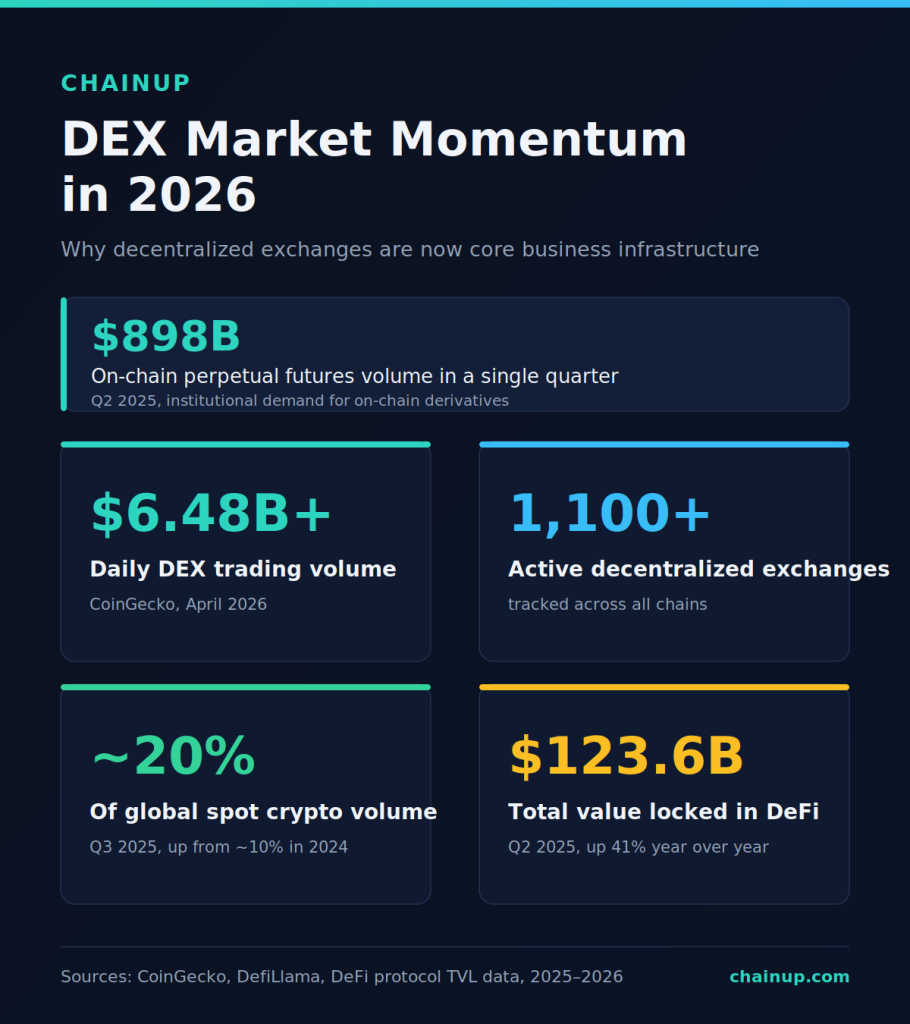
Decentralized exchanges are no longer a retail experiment. As of April 2026, CoinGecko tracked more than 1,100 DEXs processing over $6.48 billion in daily volume, and DEXs handled roughly 20% of global spot crypto trading in Q3 2025, up from about 10% a year earlier. On-chain perpetual futures volume reached $898 billion in a single quarter.
For corporate treasuries, trading desks, and funds, the question has shifted from whether to trade on-chain to how to do it with institutional controls in place.
This is the operational playbook on why enterprises are moving on-chain, the five steps to execute compliant DEX trading, and how to evaluate the infrastructure that makes it safe at scale.
Beyond the CEX: Why Modern Enterprises Are Migrating On-Chain
Centralized exchanges custody your funds. That single fact drives most of the risk enterprises are now moving to eliminate. Five advantages explain the migration:
- Eliminating counterparty risk (self-custody). On a centralized exchange, the platform holds your corporate funds. A liquidity crisis, a withdrawal freeze, or a bankruptcy can damage your balance sheet overnight. Trading on-chain, enterprises retain 100% ownership of their private keys via corporate multi-sig wallets and interact directly with smart contracts, removing the platform as a middleman.
- On-chain yield and programmability. Funds sitting idle on a centralized platform generate zero commercial utility. On-chain, treasuries can deposit idle assets into liquidity pools to capture yield from protocol trading fees, and automate hedging and rebalancing logic directly through smart contract commands.
- Immediate access to emerging assets. Centralized listings are slow, strict, and costly. Professional funds that need early exposure to new token launches and niche ecosystem tokens can access them on-chain weeks or months before they reach CEX order books.
- Continuous, atomic settlement. Traditional and centralized rails depend on clearinghouses, manual banking, and batch delays. On-chain, settlement is instantaneous, programmatic, and atomic. The asset swap and clearing occur in the same block, sharply increasing capital velocity.
- Censorship resistance and transparency. A distributed blockchain can’t be shut down by a single entity, and every transaction is publicly verifiable on-chain, a clean, unalterable audit trail for tax and compliance teams.
How to Trade on a DEX as a Business in Five Steps
The workflow below turns DEX trading into a repeatable internal process that any operations team can follow.
Step 1: Establish Institutional MPC & Multi-Sig Custody Frameworks
An enterprise cannot risk corporate funds on a standard single-signature hardware wallet. Operations teams deploy institutional MPC (Multi-Party Computation) custody engines integrated alongside programmatic multi-signature frameworks.
This lets the treasury configure strict IAM (Identity and Access Management) policies, hard-coding risk controls into the workflow and separating organizational roles:
- Initiators / Operators: traders who draft and queue transactions.
- Approvers / Admins: executives or compliance officers required to cryptographically sign off on any movement of funds.
- Auditors: read-only access keys for internal legal and accounting teams.
Step 2: Execute Compliant Fiat On-Ramping and Gas Capitalization
Before interacting with smart contracts, the wallet must be capitalized with native network tokens (e.g., ETH, BNB, or ARB) to cover gas. Corporate compliance dictates these assets cannot be sourced through standard retail channels.
Treasury teams route fiat through institutional OTC desks or regulated banking portals that perform rigorous source-of-wealth checks. Once acquired, the native tokens are transferred into the corporate custody engine and categorized as Operational Expenses (OpEx) within the treasury management system.
Step 3: Select Vetted, Permissioned, or White-Label DEX Infrastructure
To avoid legal and regulatory liability, institutional traders rarely interact with unverified public pools like trading in anonymous pools risks unknowingly transacting with sanctioned or illicit wallets. Instead, professional entities use:
- Permissioned institutional DeFi pools: platforms that mandate strict KYC/AML verification for every liquidity provider and participant.
- Enterprise white-label DEX infrastructure: corporate-branded exchange environments that let a business control exactly which networks, assets, and verified counterparties are permitted within its trading environment.
The choice comes down to how much control, compliance assurance, and counterparty verification your trading mandate requires.
Step 4: Execute Algorithmic Router Optimization and Slippage Mitigation
Deploying enterprise-scale capital into a single liquidity pool triggers severe slippage and immediate capital degradation. Worse, public transactions are exposed to MEV (Maximal Extractable Value) bots that front-run or “sandwich” corporate orders.
To mitigate execution risk, professional trading desks use institutional meta-aggregators and private RPC (Remote Procedure Call) nodes such as Flashbots Protect. This routes orders silently off-mempool and splits large blocks across dozens of compliant liquidity venues simultaneously, minimizing market impact and securing optimal execution price.
Step 5: Automate Web3 Sub-Ledger Accounting and ERP Reconciliation
The final phase bridges on-chain data with traditional corporate finance. Raw cryptographic transaction receipts and gas histories are effectively unreadable to standard accounting software.
Enterprises deploy Web3 sub-ledger tools such as Bitwave or Integral, to continuously scrape wallet activity from the blockchain. The software tracks cost basis, calculates realized gains and losses, and maps gas fees directly into ERP systems like Oracle NetSuite, SAP, or QuickBooks, producing a continuous, auditable trail ready for quarterly reviews and tax filing.
How to Evaluate Institutional Digital Asset Trading Infrastructure
When choosing where and how to trade, weigh the infrastructure against the capabilities that actually protect capital and satisfy compliance:
| Capability | Why it matters for trading |
| Multi-chain liquidity aggregation | Fills large orders across Ethereum, BNB Chain, and Polygon with minimal slippage |
| Built-in KYC/AML & permissioning | Keeps counterparties verified and trades audit-ready |
| Custody integration (MPC / multi-sig) | Preserves self-custody and role-based approval controls |
| Smart order routing & MEV protection | Shields large orders from front-running and sandwich attacks |
| Real-time reporting & API access | Feeds on-chain activity straight into treasury and ERP systems |
The right route, whether public, permissioned, or white-label, depends on how much branding, compliance depth, and execution control your desk requires.
Why Enterprise-Grade Infrastructure Matters
On-chain trading rewards preparation and punishes improvisation. The line between capturing on-chain opportunities and suffering a compliance failure or drained treasury comes down to one thing: your technical stack.
You need custody that enforces internal approvals, on-ramps that survive an audit, trade routing that blocks MEV exploits, and sub-ledgers that close the books cleanly.
When built on enterprise-grade infrastructure rather than makeshift tools, on-chain trading becomes a reliable, repeatable corporate operation.
Powering On-Chain Enterprise Operations with ChainUp
ChainUp provides the institutional-grade infrastructure behind each of these steps with MPC and multi-sig custody integration, compliant liquidity access with built-in KYC/AML, multi-chain smart order routing, and reporting that reconciles directly into enterprise finance systems.
It’s a full ecosystem designed to support your desk at every stage of the trading lifecycle, not a single tool. If your team is building out on-chain trading operations, let’s explore what we can do for you.