Key Takeaways
- The estimated $130M Coldcard exploit proved that offline hardware fails if built on a single cryptographic key. A firmware flaw reduced key entropy down to a brute-forceable 40 bits, allowing remote extraction without breaching the physical device.
- Security concerns sparked a 2026 record of 890,000 BTC moved in a single week, highlighting the market’s recurring dilemma between single-seed self-custody and counterparty-heavy centralized exchanges.
- Institutional digital asset custody requires removing single points of failure at the mathematical layer. Multi-Party Computation (MPC) splits key generation and threshold signing across independent shares so no master private key ever exists in memory or on disk.
- Enterprise-grade MPC models—such as 2-of-3 threshold framework distributed across client-held keys and independent cloud environments (e.g., Azure and AWS)—maintain non-custodial ownership alongside auditable governance and regulatory compliance.
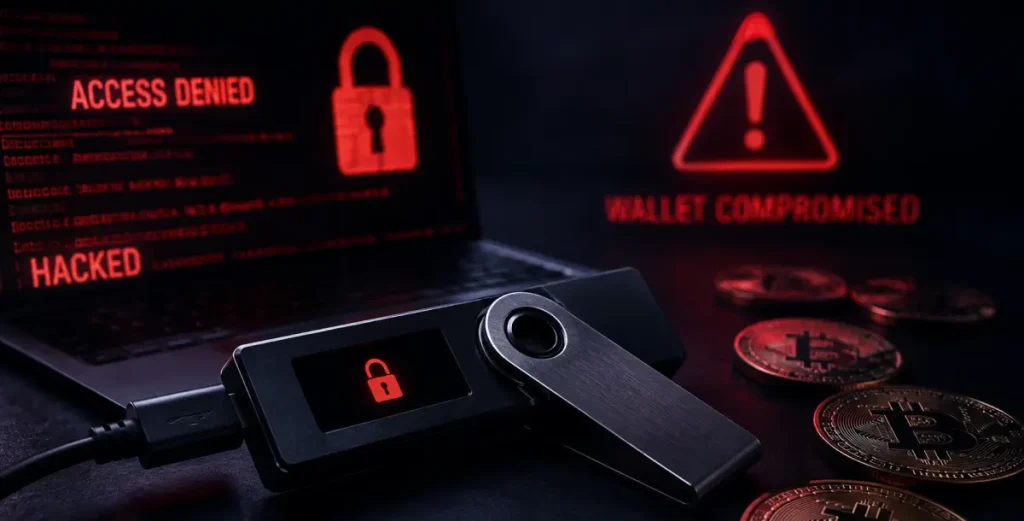
On July 30, 2026, the foundational narrative of crypto self-custody suffered its most structural test to date. Attackers began systematically draining Bitcoin from Coldcard hardware wallets—long considered the gold standard for security-conscious holders and institutional desks alike.
This was not an elaborate phishing campaign, a social engineering breach, or a live remote hack of physical hardware. It was a five-year-old firmware flaw within Coinkite’s Coldcard architecture.
The speed and scale of the initial exploitation were staggering. In the first wave alone, approximately 1,082 BTC was swept from 1,196 addresses in just 41 minutes. As security researchers worked to map the blast radius, the figures mounted. Initial estimates from Galaxy Research quickly scaled from $100 million to roughly $130 million (approximately 2,000 BTC), capturing both confirmed and suspected thefts. Independent analysis from K33 separately identified roughly 1,596 BTC stolen across 7,300 unique addresses.
Coldcard Exploit: Initial Impact at a Glance
- Time to Initial Drain: ~41 Minutes
- First-Wave Losses: 1,082 BTC (1,196 addresses)
- Total Estimated Impact: ~$130M / ~2,000 BTC (Up to 7,300 addresses)
- Independent Attacker Groups: 15+ Distinct Entities
Crucially, Galaxy Research confirmed that this was not the work of a single, omniscient threat actor. At least 15 different attackers exploited the open vulnerability independently. A flaw baked into a device designed specifically to be the safest option on the market had turned self-custody into an open target.
The Root Cause: Cold Storage Wasn’t Actually Cold
To understand why this breach occurred, one must look past the physical hardware element and examine how entropy—the mathematical randomness required to generate cryptographic keys—was handled.
The vulnerability traced back to a single code commit from March 2021. A modification in the firmware routed seed generation through a software-based pseudorandom number generator (PRNG) seeded from public, hardcoded constants, rather than relying strictly on the device’s dedicated hardware random number generator (TRNG).
In plain terms, the device was engineered to generate wallet seeds using unpredictable hardware randomness. Instead, a programming error forced it to use a predictable, deterministic software substitute.
- Expected Architecture: True Hardware Entropy (TRNG) → 128-bit Unpredictable Seed →Cryptographic Private Key
- Exploited Architecture (March 2021 Commit): Hardcoded Public Constants → Deterministic Software PRNG → 40-bit Brute-Forceable Key
The mathematical consequences were catastrophic. The effective security strength of generated keys collapsed from an industry-standard 128 bits down to as little as 40 bits on affected devices. At 40 bits of entropy, modern cloud computing clusters can brute-force the search space and reconstruct the private keys in minutes without ever gaining physical access to the device or breaching the secure hardware element itself. The physical chip remained uncompromised; the secret it was instructed to guard was flawed from the moment of creation.
Multi-signature (multisig) configurations provided a clear line of defense. Because a compromised Coldcard represented only one signature in a multi-key setup (such as a 2-of-3 quorum), attackers holding the weak key could not move funds unilaterally. This distinction highlights the critical flaw of single-key architectures: single points of failure remain inherently vulnerable, regardless of how offline the physical device appears.

The Ripple Effect: Onchain Velocity and Market Realignment
The systemic nature of the exploit triggered an immediate, measurable shift in onchain behavior across the broader market.
Onchain data compiled by K33 Research revealed that Bitcoin’s seven-day active supply climbed to a 2026 high during the event, with approximately 890,000 BTC transacting in a single week. This sharp increase in coin movement was particularly notable given the prevailing market environment: Bitcoin had been consolidating within its narrowest 30-day price corridor since 2023, with realized volatility temporarily compressing below equity benchmarks like the Nasdaq 100.
Rather than price-driven speculation, this divergence between low price volatility and elevated transaction volume signaled widespread capital reallocation. As active supply metrics spiked, anxiety extended beyond Coldcard users to broader hardware wallet architectures—including Ledger and Trezor setups—prompting holders to evaluate alternative custody models. Historically, sharp contractions in dormant supply cluster around major market turning points, whether driven by macro liquidity shifts, systemic insolvencies, or structural security events.
| Epoch / Market Context | Primary Onchain Driver |
| 2022 Bear Market | Counterparty Insolvencies & Forced Liquidations |
| 2024–2025 Bull Market | Systematic Profit-Taking & Capital Rotation |
| July–August 2026 | Hardware Architecture & Firmware Vulnerabilities |
This flight to liquidity also drove a marked increase in capital flows back toward centralized trading venues, reflecting a well-documented pendulum swing in digital asset market structure. Following the centralized exchange collapses of 2022, capital heavily migrated into self-custody solutions. Conversely, hardware and firmware failures in self-custody environments routinely push capital back toward tier-one exchanges, where operational oversight, dedicated security operations centers (SOCs), and automated threat detection absorb individual operational risk.
However, viewing this dynamic as a binary trade-off between retail hardware wallets and fully centralized exchange risk overlooks a key institutional alternative: self-custody built on distributed, multi-party architecture.
The Pattern Nobody Wants to Name
Coldcard isn’t isolated — it’s the third act in a pattern 2026 keeps repeating. Bybit lost $1.4 billion to a compromised signing process. Blockaid recorded over $1 billion in exploits industry-wide in H1 2026 alone, a record. Now Coldcard: a five-year-old software flaw inside hardware marketed as the gold standard.
Three different custody models, three different technologies but same failure mode – a single point of trust nobody outside the vendor could verify until it broke.
That’s the uncomfortable part. Coldcard users didn’t cut corners — they followed best practice to the letter. The flaw wasn’t user error; it was buried in code that had passed years of community scrutiny. If anything, this was crypto’s most security-literate cohort, and the exploit still worked.
Which points to the real lesson: this isn’t self-custody vs. exchanges. Both have now failed publicly and expensively in 2026. The actual divide is verifiable architecture vs. trusted architecture — whether a single point of failure can be independently confirmed absent, or simply assumed away until something breaks.
For exchanges and platforms, the takeaway isn’t “switch to MPC.” It’s narrower: any custody model, including your own, is one untested assumption from being the next case study. The question isn’t which vendor to trust more — it’s what in your own stack has never been tested against failure, only assumed safe because nothing’s gone wrong yet.
What “Institutional-Grade” Custody Actually Means
For digital asset exchanges, trading desks, and fintech platforms, the Coldcard event serves as an important case study: custody infrastructure is defined by its core structural assumptions.
The fundamental risk factor in digital asset management remains the single point of failure (SPOF). Whether represented by a single seed phrase stored on paper, an offline hardware wallet reliant on a single firmware build, or an individual executive holding master private key access, single-key architectures present clear operational risks.
True institutional-grade custody moves away from reliance on single secrets and vendor promises, requiring structural verification across key operational pillars:
- Architectural Dispersion: Zero single points of key generation, storage, or transaction signing.
- Tiered Asset Management: Integrated hot, warm, and cold wallet infrastructure with automated threshold routing to optimize operational liquidity without sacrificing deep cold storage security.
- Auditable Control: Cryptographic proof of control over static vendor trust.
- External Certification: SOC 2 Type II, ISO/IEC 27001, 27017, and 27018 compliance frameworks.
- Operational Resilience: Built-in multi-party governance, role-based access, and automated policy controls.
The key takeaway from the Coldcard incident is not that hardware isolation is ineffective, but that physical isolation alone cannot compensate for a single-key design. Security depends on key architecture, not just physical storage location.
The Structural Fix: Multi-Party Computation (MPC)
Multi-Party Computation (MPC) addresses the single-key problem directly at the mathematical layer.
Rather than generating a single private key or seed phrase in one place and attempting to shield it, MPC splits the key creation and signing processes across multiple independent mathematical shares. At no point during key generation, storage, or transaction signing does a complete private key exist in whole form on any single device, server, or location.
Single-Seed vs. MPC Architecture
- Single-Seed Model (e.g., Coldcard): A single device generates a full private key, creating a single point of failure.
- MPC Architecture Model: Key shares are split across distinct entities (e.g., Client Share, Cloud Provider A Share, Cloud Provider B Share). A threshold signature scheme executes transactions without ever constructing the full key in memory or on disk.
How MPC Eliminates Single Points of Failure
- Distributed Key Generation (DKG): Key shares are created independently in parallel across distinct environments (e.g., local client devices, isolated cloud environments, and geographically separated data centers).
- Threshold Signing: A pre-defined threshold of shares (e.g., 2-of-3) must interact via cryptographic protocols to sign a transaction. The mathematical signature is valid, but the shares themselves remain separate throughout the process.
- Fault Tolerance: If a single share is exposed, lost, or compromised through a firmware flaw or device breach, the underlying private key remains secure. The attacker gains an incomplete fragment that cannot sign transactions on its own.
While MPC replaces single-secret vulnerabilities with distributed management requirements, this trade-off aligns well with institutional operations, where policy-driven access controls and multi-party governance are standard requirements.
Applied MPC Architecture & Evaluation Framework
As platforms re-evaluate their operational setup following the Coldcard event, modern institutional custody implementations demonstrate how these distributed principles operate in practice.
When evaluating custody architecture, platforms and institutional teams should consider the following baseline parameters:
- Elimination of Single Points of Failure: Verification that key generation, storage, and transaction execution never reconstruct a full key in a single location.
- Separation of Duties: Operational isolation separating the technology provider, platform operators, and policy approvers.
- Independent Certification Standards: Third-party verification including SOC 2 Type II compliance along with ISO/IEC 27001, 27017, and 27018 standards.
- Integrated Compliance Controls: Native integration of Know-Your-Customer (KYC), Anti-Money Laundering (AML), and real-time Know-Your-Transaction (KYT) monitoring directly within transaction workflows.
- Demonstrated Operational Track Record: Proven performance under peak network volume and volatile market conditions.
Re-Architecting Digital Asset Custody
The Coldcard exploit serves as a clear reminder that offline storage alone does not guarantee security if the underlying key architecture contains a single point of failure. When single-seed designs fail, the market reaction is immediate—reflected in elevated onchain activity and capital migration across venues. Moving forward, securing digital assets requires asking a fundamental question about system design:
“If any single component in our custody stack fails, does the security of the entire platform fail with it?”
To answer this, modern institutional custody implementations deploy distributed, cryptographic frameworks engineered for structural durability. ChainUp’s Non-Custodial White Label MPC Wallet provides a prime example of this architecture in practice:
- Distributed Share Architecture: Private key creation uses a 2-of-3 threshold signature scheme. One key share resides securely with the client, while the remaining two shares are hosted in isolated, highly secure infrastructure across Microsoft Azure and Amazon Web Services (AWS).
- Multi-Layered Governance: Key share computation is reinforced with multi-signature rules, hardware-enclosed execution, and customizable Role-Based Access Control (RBAC) engines tailored to institutional workflows.
- Certified Compliance Stack: Built to meet international security standards (including SOC 2 Type II and ISO certifications), integrated directly with automated KYC/AML controls and real-time KYT tracing engines.
By eliminating single-seed vulnerabilities while maintaining full operational control over funds, ChainUp offers the custody infrastructure exchanges, institutional platforms, and asset managers need to rebuild trust and ensure long-term resilience.
Ready to modernize your custody architecture? Contact the ChainUp team today to explore our institutional MPC infrastructure.