In Q4 2025, Tether’s USDT reached a record market capitalization of $187.3 billion, adding $12.4 billion in a single quarter while facilitating more than $4.4 trillion in on-chain transfers. Today, Tether holds roughly 59% of the total stablecoin market, with Tether and USDC together accounting for approximately 93% of all stablecoin capitalization.
That scale makes USDT the dominant stablecoin in crypto, serving as a core trading pair, settlement asset, and liquidity layer across exchanges, DeFi platforms and cross-border payment flows. Its influence comes from reach: USDT is available on nearly every major exchange, widely used in emerging markets and increasingly treated as crypto’s default dollar-denominated asset.
Tether’s move in March 2026 to engage KPMG for a full external reserve audit also signals a push toward stronger institutional confidence. So what exactly is USDT, how does it maintain its $1 value and why does it matter so much to the future of digital finance?
What Is USDT?
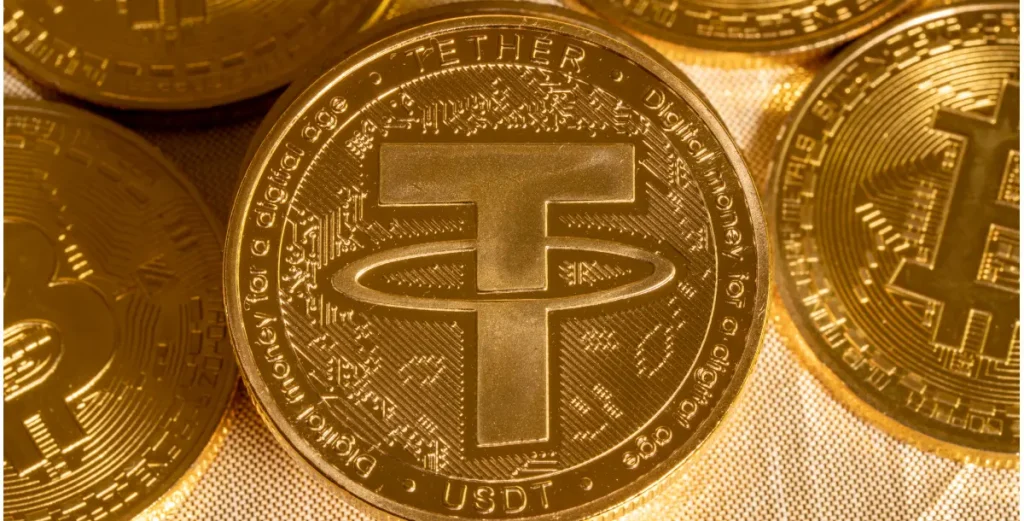
USDT, short for US Dollar Tether, is a stablecoin, a type of cryptocurrency designed to maintain a stable value relative to a reference asset, in this case the US dollar. Issued by Tether Limited, each USDT token is pegged 1:1 to the US dollar, meaning one USDT is always intended to be worth approximately one US dollar.
Unlike Bitcoin or Ethereum, whose prices can swing dramatically within hours, USDT is engineered for stability. It gives users all the benefits of transacting on a blockchain such as speed, transparency, borderless transfers, and programmability without the volatility that makes most cryptocurrencies impractical as a medium of exchange or unit of account.
In practical terms, USDT is the internet’s digital dollar, and understanding how it works is becoming increasingly essential for anyone participating in modern digital finance.
How Does Tether Maintain Its $1 Peg?
The core question behind any stablecoin is why the price does not move. For USDT, the answer comes down to a reserve-backed model built on a straightforward principle.
The Reserve System
USDT works on an IOU model. For every USDT issued, Tether is expected to hold an equivalent value of reserves and allow holders to redeem 1 USDT for 1 U.S. dollar.
Those reserves are not held entirely in cash. Based on Tether’s recent disclosures, they include cash and cash equivalents, secured loans and other investments. The largest portion is U.S. government debt, with Tether’s Treasury exposure reportedly reaching $141.6 billion by the end of Q4 2025.
This reserve structure matters because the peg depends on trust in Tether’s ability to honour redemptions. In simple terms, USDT works like a digital claim on dollar-backed reserves: the token holds value because users believe the issuer has enough liquid assets to support every token in circulation.
Minting and Burning
USDT tokens are created, or minted, when authorized users or institutions deposit equivalent fiat currency with Tether Limited. When tokens are redeemed for fiat, those tokens are destroyed, or burned, and the circulating supply decreases accordingly.
This dynamic supply mechanism keeps the outstanding amount of USDT aligned with actual demand and is a key reason the peg stays stable even as market conditions shift.
Proof of Reserves
Tether commits itself to transparency through an accessible proof-of-reserves mechanism and publishes its reserves on its official website so users can track them directly.
Beyond daily reserve updates, Tether releases quarterly attestation reports breaking down the reserve composition by asset class.
In March 2026, Tether also engaged KPMG for a full external audit to verify its reserves, a move that marks a significant step toward the institutional-grade verification that regulated markets increasingly require.
What Blockchain Does USDT Run On?
One of USDT’s core strengths is its multi-chain architecture. Rather than being confined to a single blockchain, USDT is natively available across 10 different blockchain networks, with broader availability through bridges and wrapped versions on 16 or more chains.
The two dominant networks are TRON and Ethereum. Over 60% of the total USDT supply, roughly $78 to $80 billion, resides on TRON, reinforcing its role as the primary settlement network.
TRON’s TRC-20 standard for USDT is especially popular for retail users and remittance flows because of its extremely low transaction fees. Ethereum’s ERC-20 version of USDT, on the other hand, is more deeply integrated with DeFi protocols and institutional platforms, making it the preferred choice for on-chain applications that require composability with the broader Ethereum ecosystem.
USDT is also available on Solana, Avalanche, TON, Algorand, and a growing list of other chains, giving users and developers the flexibility to choose networks based on their specific needs around speed, cost, and ecosystem fit.
This multi-chain strategy is a key reason USDT has maintained its dominance. By meeting users wherever they already are, Tether has avoided the fragmentation that limits many of its competitors.
What Are the Main Use Cases for USDT?
USDT was initially adopted primarily by crypto traders, but its role has expanded significantly over the past decade. It now functions as foundational financial infrastructure across several distinct and growing use cases.
Trading and Liquidity
USDT is one of the most widely used base trading pairs across centralised and decentralised exchanges. Traders use it to move out of volatile assets without leaving the crypto ecosystem, while market makers and arbitrage traders rely on its deep liquidity.
Decentralized Finance
In DeFi, USDT is used for lending, borrowing, liquidity pools, collateral and yield strategies. Its stable value makes it useful for users who want on-chain exposure without holding highly volatile assets.
Cross-Border Payments and Remittances
USDT enables faster and lower-cost international transfers compared with traditional correspondent banking rails. It is especially useful in regions where access to U.S. dollar banking is limited.
Business Settlements and Payroll
Businesses use USDT for supplier payments, B2B settlements and global payroll. Its dollar peg helps reduce FX volatility while allowing faster settlement across borders.
Savings in High-Inflation Economies
In markets with unstable local currencies, USDT gives users access to dollar-denominated value without requiring a U.S. bank account. This makes it a practical store of value for individuals and businesses facing currency pressure.
USDT vs. Other Stablecoins
USDT is the largest stablecoin by liquidity and market reach, but it is not the only model in the market. Each stablecoin type has different strengths depending on whether the priority is liquidity, regulatory positioning, decentralisation or reserve structure.
| Comparison | Key Difference | USDT’s Position |
| USDT vs. USDC | USDC is often viewed as more transparency-focused and regulation-oriented, while USDT leads in liquidity and global exchange usage. | USDT remains stronger for high-frequency trading, arbitrage and markets that need deep liquidity. |
| USDT vs. DAI | DAI is a decentralised, overcollateralised stablecoin governed by MakerDAO, while USDT is centrally issued by Tether. | USDT offers greater liquidity and scale, while DAI offers more decentralisation but more complexity. |
| USDT vs. Algorithmic Stablecoins | Algorithmic stablecoins rely on supply mechanisms instead of full reserve backing, making them more vulnerable during confidence shocks. | USDT’s reserve-backed model has proven more resilient than algorithmic designs during market stress. |
Why USDT Matters for the Future of Digital Finance
In 2025, Tether facilitated about $13.3 trillion in transaction volume, representing a major share of the record $33 trillion in total stablecoin flows that year. The broader trajectory of the stablecoin market reinforces this picture. The global stablecoin market is projected to exceed $3.7 trillion by 2030, driven by institutional adoption, regulatory clarity, and the maturation of blockchain-based payment rails.
For businesses, exchanges, financial institutions, and developers building on blockchain infrastructure, USDT is not an optional consideration. It is the common denominator of the digital asset economy, and building the capability to work with it effectively is becoming a baseline requirement for competitive participation in digital finance.
Building on the Stablecoin Economy
USDT is more than a trading tool. It is the foundation of a new financial infrastructure that is moving trillions of dollars, enabling access to stable value for millions of people, and bridging the gap between traditional finance and the digital asset economy.
Understanding how it works is the first step. Building on top of it is where the real opportunity begins.
At ChainUp, we have been powering that infrastructure since 2017. Trusted over 1,000 global clients, ChainUp provides the full stack that businesses need to participate in the stablecoin economy.
From white-label crypto exchange infrastructure supporting multi-chain and fiat or stablecoin pairs, to MPC wallet solution with institutional-grade security and compliance toolsets built in, our solutions are designed to help regulated institutions move fast and build with confidence.
Whether you are a financial institution exploring stablecoin-powered services, a fintech building payment rails, or an exchange looking to integrate USDT liquidity at scale, we have the infrastructure and expertise to support you.
Explore ChainUp’s digital asset solutions and discover how we can help your business lead in the next chapter of digital finance.
Frequently Asked Questions
Is USDT safe to hold?
USDT is backed by reserves held by Tether Limited, including US Treasury Bills and cash equivalents. It has maintained its $1 peg through multiple market downturns. However, as with any centrally-issued asset, it carries counterparty and regulatory risk that users should understand before holding significant amounts.
What is the difference between TRC-20 USDT and ERC-20 USDT?
Both represent USDT but operate on different blockchains. TRC-20 on TRON offers lower transaction fees and faster confirmation, making it ideal for frequent transfers and remittances. ERC-20 on Ethereum is more deeply integrated with DeFi protocols and institutional platforms. Always ensure you are sending to the correct network, as sending USDT to the wrong chain address can result in permanent loss of funds.
Can USDT lose its peg?
USDT has experienced minor, short-lived depegging events during periods of extreme market stress, but it has consistently recovered. Its reserve structure is designed to support large-scale redemptions, and its track record through events like the 2022 bear market has demonstrated meaningful resilience compared to algorithmic alternatives.
How is USDT different from Bitcoin?
Bitcoin is a volatile, decentralized cryptocurrency with a fixed supply and no central backing authority. Its price fluctuates based on market demand and sentiment. USDT is a centrally-issued stablecoin backed by fiat reserves and designed specifically for price stability rather than appreciation. The two assets serve fundamentally different purposes in a crypto portfolio or business operation.