Bitcoin lit the match; altcoins built the fireworks.
Over the last decade, this market has fueled crypto’s most explosive wealth—from Ethereum’s evolution into a global settlement layer to Solana’s (SOL) high-speed trading booms. Yet, for every breakout, there is a wipeout. From vanished liquidity to fatal exploits, altcoins are where innovation and extreme risk live side-by-side.
That’s why this topic matters. Altcoins are where most innovation (and most risk) lives: new chains, Decentralized Finance (DeFi) primitives, stablecoins that power trading, and token models that can make a protocol grow—or quietly dilute holders into the ground. To navigate 2026, you must know how to separate durable networks from passing hype.
What Is An Altcoin?
An altcoin is any crypto asset that launched after Bitcoin (BTC) and sits outside the “Bitcoin-only” bucket. In most everyday usage, altcoin is everything except BTC. Some writers also exclude Ethereum (ETH) because ETH has become a core smart-contract settlement layer and behaves like its own category, so they use altcoin to mean everything except BTC and ETH.
The important part: “altcoin” describes what something is not, not what it is. That’s why the label covers assets that behave nothing alike:
- Network coins that secure and pay for activity on blockchains (ETH, SOL, AVAX-type roles)
- Application tokens that power specific protocols (Decentralized Exchange DEX, lending, gaming, AI, etc.)
- Governance tokens that grant voting rights over a protocol’s rules or treasury decisions
- Stablecoins designed to track fiat value for payments and trading
- Memecoins driven mostly by community, attention, and speculation
So when someone says “altcoin,” the real question is: what kind of altcoin, and what job does it do?
Why Do Altcoins Exist?
Bitcoin deliberately stays focused: censorship-resistant, decentralised value transfer with a conservative approach to upgrades. That narrow scope protects reliability, but it also leaves room for other networks to ship different capabilities faster.
Altcoins exist because different chains optimize for different real-world utility. Instead of one “best” blockchain, the market ends up with specialised networks that create value in different ways—by making apps possible, making transactions cheaper, making settlement faster, or making certain financial workflows programmable. In other words: altcoins compete on what the chain can do and who it serves, not just on price.
Altcoins often exist to deliver utility like:
Add programmability (smart contracts)
Many altcoins aim to be application platforms, not just money. Smart contracts let developers build DeFi, Non-Fungible Tokens (NFTs), tokenised assets, Decentralized Autonomous Organizations (DAOs), games and on-chain identity systems. This created entire ecosystems that Bitcoin wasn’t designed to host natively.
For example, Ethereum (ETH) popularized general-purpose smart contracts, which enabled major DeFi protocols and NFT standards to run directly on-chain.
Increase throughput or reduce fees
Some networks prioritise speed and low transaction costs—higher throughput, faster finality and cheaper execution—often by changing how they structure consensus, hardware expectations or validator requirements.
For example, Solana (SOL) targets high throughput and low fees, which is why it attracts high-frequency trading-style DeFi activity and high-volume consumer apps that would be cost-prohibitive on higher-fee networks.
Build specialized ecosystems
Some altcoins optimise for a specific niche:
- DeFi-first networks that focus on composability and liquidity
- Gaming ecosystems that support high-frequency microtransactions
- Privacy networks that prioritise transaction confidentiality
- Identity / data networks that focus on credentials, messaging, storage, or compute
Create new economic models
Altcoins also experiment with token economics:
- Staking rewards to incentivise validators and long-term participation
- Burn mechanisms to reduce supply or offset issuance
- Protocol revenue sharing or fee routing to treasuries, stakers, or token holders
These designs affect incentives, security, and how value accrues (or doesn’t) to the token. For example, BNB (BNB Chain) uses a burn mechanism (regular token burns tied to network activity/targets) to reduce circulating supply over time, which is a very different value-accrual approach from fixed-supply narratives or pure inflationary reward models.
Support stable-value settlement (stablecoins)
Stablecoins exist because users and businesses need price stability for payments, payroll, remittances, trading collateral, and treasury operations. They often sit inside the altcoin umbrella, even though they behave more like cash equivalents than speculative assets.
Altcoin vs Coin vs Token
People use these terms interchangeably, but they describe different things. Coin and token tell you where the asset lives and how it’s issued. Altcoin is a market label that tells you what it isn’t (Bitcoin, and sometimes Ethereum).
| Term | What it means | Where it “lives” | What it’s used for | Examples | Quick test |
| Coin | The native asset of its own blockchain | On its own L1/L2 chain | Pays network fees, often secures the chain (staking/mining), may be used for governance | SOL (Solana), AVAX (Avalanche), ETH (Ethereum) | If the network stops, the coin’s primary function stops because it’s the chain’s native asset |
| Token | An asset issued on top of another blockchain via a smart contract | On an existing chain (e.g., Ethereum, Solana) | Can represent almost anything: governance rights, app utility, stable value, points, in-game items, claims on reserves | ERC-20 tokens on Ethereum; NFTs (ERC-721/1155) | If the base chain stops, the token can’t move or execute because it depends on that chain’s security and execution |
| Altcoin | A broad market term for crypto other than Bitcoin (sometimes other than BTC + ETH) | Can be a coin or token | Catch-all category: smart-contract platforms, stablecoins, DeFi tokens, governance tokens, memecoins, etc. | Anything outside BTC (and sometimes ETH) | If it’s not Bitcoin (and sometimes not Ethereum), people call it an altcoin—regardless of what it does |
Examples of Major Altcoins
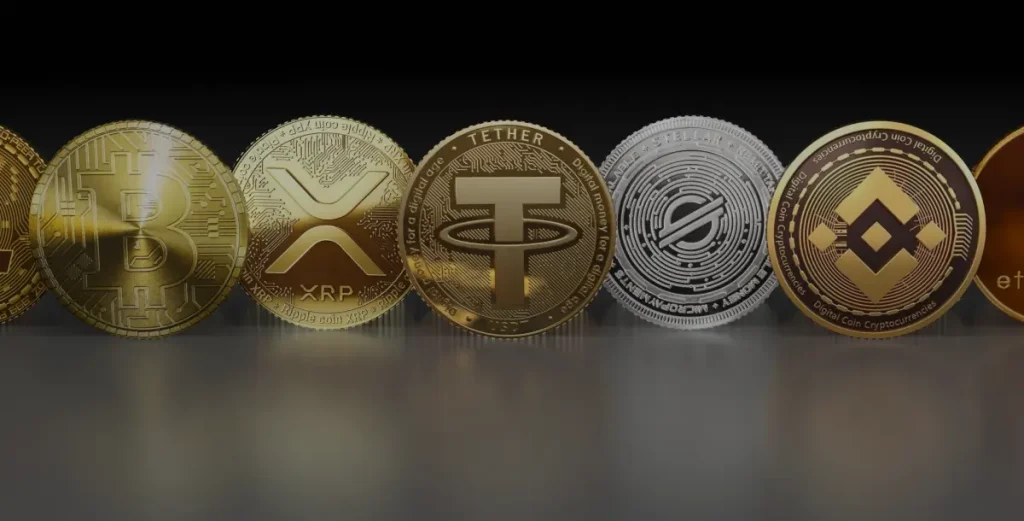
A CoinMarketCap Historical Snapshot ranked the largest non-Bitcoin assets by market cap as Ethereum (ETH), Tether (USDT), XRP, BNB, USDC, Solana (SOL), and TRON (TRX).
That mix matters because it proves one point fast: “altcoin” isn’t a single asset type. The biggest names include smart-contract platforms, stable-value settlement rails, and network/payment tokens—each with different risk drivers, user bases, and value mechanics.
Ethereum (ETH): smart-contract settlement + gas
ETH sits at the center of programmable crypto. Users pay fees in ETH to execute smart contracts, and builders treat Ethereum as a settlement layer for DeFi, NFTs, token issuance, and Layer 2 rollups. ETH’s role ties directly to activity: more usage often means more fee demand and more ecosystem gravity.
ETH matters in the real world because it functions as the “fuel” for programmable finance and digital asset rails, not just another coin to trade. Every swap on a DEX, stablecoin transfer, lending position, NFT mint, tokenizsed asset issuance, or on-chain business workflow needs computation and settlement, and users pay for that execution in ETH.
That’s why Ethereum has grown into a large economic layer: it hosts a huge share of DeFi activity and stablecoin circulation, alongside the Layer 2 rollups that settle back to Ethereum for security. As a snapshot of that footprint, DeFiLlama’s Ethereum chain dashboard shows tens of billions in DeFi TVL and well over $100B in stablecoins tracked on Ethereum, which helps explain why builders treat Ethereum as a core settlement layer rather than a niche network.
Tether (USDT): stablecoin liquidity engine
USDT shows up near the top because stablecoins act like the market’s “cash layer.” Traders use USDT as a quote currency, exchanges use it for liquidity, and cross-border users use it for stable-value transfers. Its risk profile looks nothing like a typical altcoin: it revolves around issuer/custody/reserve mechanics, not protocol adoption.
USDC: regulated-leaning stablecoin for rails and DeFi
USDC sits beside USDT because stablecoins dominate real on-chain settlement. Markets use USDC heavily across exchanges, DeFi protocols, and payment flows. Like USDT, it behaves more like “programmable cash” than a speculative network token, so you evaluate it through issuance/redemption design and governance/issuer risk—not “altcoin season momentum.”
XRP: payment/network token with deep legacy liquidity
XRP’s position reflects long-standing liquidity and a focus on payments-style messaging and transfer use cases. It often trades heavily during market rotations, and it behaves differently from smart-contract platforms because it doesn’t rely on “apps driving gas demand” the same way ETH or SOL does.
BNB: exchange ecosystem + chain utility
BNB blends two realities: an ecosystem token tied to a major trading venue’s product universe and a fee/utility asset for BNB Chain activity. That combination can concentrate demand (fees, discounts, on-chain usage) but it also concentrates exposure to ecosystem and platform-specific risks.
Solana (SOL): high-throughput smart-contract platform
SOL represents the “speed + low fee” smart-contract category. When users want high-frequency activity—trading, consumer apps, NFTs—chains like Solana compete by keeping per-transaction costs low and throughput high. Its value often tracks ecosystem usage, developer traction, and reliability under load.
TRON (TRX): payments-style network effects (often stablecoin-heavy)
TRX appears because TRON runs a large volume of value transfer activity, especially in stablecoin-style flows on its network. Like XRP, it fits more into “network/payment rail” dynamics than the pure “smart-contract settlement premium” story.
Types of Altcoins
Use this table to map an altcoin to what it actually does.
| Altcoin type | What it does | Typical examples | What to look for |
| Smart-contract platforms (L1s) | Base layer blockchains where apps run | ETH, SOL, AVAX | Developer adoption, security model, decentralisation, fees, uptime |
| Layer 2 tokens (L2s) | Scale a base chain (often Ethereum) | OP, ARB (and other L2 ecosystems) | Usage, sequencing model, decentralisation roadmap, fee structure |
| Stablecoins | Track fiat value for payments/trading | USDT, USDC | Reserve transparency, issuer risk, redemption mechanics |
| DeFi utility tokens | Power lending, DEXs, derivatives, etc. | UNI, AAVE (examples commonly covered in DeFi guides) | Real usage, protocol revenue, token utility, governance design |
| Governance tokens | Voting rights for protocol changes | Many DeFi protocols | Who can propose changes, voter concentration, treasury controls |
| Exchange tokens | Fee discounts, rewards, platform utilities | BNB-style models | Issuer risk, regulatory exposure, clear token utility |
| Memecoins | Social/speculative tokens driven by community | DOGE, SHIB | Liquidity, distribution, major holder concentration |
What Drives Altcoin Prices?
Altcoins don’t move on one factor. They usually respond to a few repeatable drivers that stack on top of each other—liquidity, attention, macro crypto flows, and token supply.
1. Liquidity and market structure
Altcoins usually trade with thinner order books than Bitcoin. That means a relatively small wave of buying or selling can move prices more aggressively.
You’ll often see:
- Sharper pumps when demand hits a token with limited sell-side liquidity
- Harder dumps when holders rush exits at the same time
- Bigger gaps and wick moves during volatility because market makers step back
- Higher slippage for large orders, which creates self-reinforcing price impact
This is why altcoins can look like they “overreact” to both good and bad news.
2. Narrative cycles
Altcoins often trade on what the market wants next, not just what is objectively strongest.
Narratives rotate in waves—AI tokens, L2s, restaking, memecoins, gaming, RWAs, modular chains—and the rotation can become its own catalyst:
- Capital piles into the “theme” even when tokens have very different fundamentals
- Influencers, listings, and social momentum amplify moves
- Short-term price action can outrun product progress (or ignore it)
In the short run, narrative can behave like a demand shock. Fundamentals usually matter more over longer timeframes, but narrative decides what gets attention now.
3. Bitcoin dominance and “altcoin season”
Traders watch Bitcoin dominance—Bitcoin’s market cap share of the total crypto market—to gauge where risk appetite sits.
The common pattern:
- Capital often flows into BTC first when markets turn bullish or uncertain
- If confidence grows, traders rotate into altcoins chasing higher beta returns
- When risk sentiment drops, flows often snap back to BTC (and sometimes stablecoins)
CoinMarketCap also tracks an Altcoin Season Index to summarise whether a broad set of altcoins are outperforming Bitcoin over a period.
Dominance isn’t a perfect signal, but it helps explain why altcoins sometimes move together, even when their individual news doesn’t justify it.
4. Token supply mechanics
Altcoin prices often react to supply changes more sharply than Bitcoin because many altcoins have active issuance schedules and event-driven supply shocks.
Key mechanics that move price:
- Emissions/inflation: steady new supply can create sell pressure if demand doesn’t keep up
- Vesting and unlocks: scheduled releases to teams/investors can increase circulating supply quickly
- Burns: supply reduction can support price if demand holds
- Staking rewards: can increase supply while also reducing float (tokens locked up), so the net effect depends on behaviour
- Treasury spending: protocols selling tokens to fund operations can weigh on price
Two tokens with the same narrative can trade very differently if one has heavy unlocks and the other has constrained supply.
How To Evaluate An Altcoin
Altcoins vary wildly in quality and risk. Use the framework below to analyze an altcoin based on what you can verify—role, supply dynamics, adoption, governance, and downside risk—rather than hype.
| Evaluation step | What to check | Why it matters |
| Identify the role of the altcoin | What must the altcoin do for the network/app to function? (fees, security, governance, collateral, access, incentives) | A token with a clear job has clearer demand drivers. If the token isn’t required for anything meaningful, price depends mainly on speculation. |
| Check tokenomics and unlocks | Total vs circulating supply, emissions/inflation, major unlock dates, team/investor allocations, treasury spending plans | Supply can overwhelm demand. Even strong products can underperform if new tokens hit the market faster than buyers arrive. |
| Validate real adoption | Active users (on-chain/app metrics), transactions, TVL (DeFi), fees/revenue (if applicable), developer activity and shipping cadence | Adoption is the closest thing to “fundamentals” in crypto. It shows whether the altcoin is tied to real behaviour or just trading flow. |
| Study governance and control points | Admin keys, multisigs, upgrade authority, who can pause contracts, governance participation and concentration | “Decentralized” often means “partially controlled.” Central control can speed execution, but it concentrates failure and trust risk. |
| Stress-test the downside | Volatility profile, liquidity depth, protocol/security history, exploit/rug pull risk, operational maturity, dependency risks | Altcoins can fail fast. Investopedia flags common risks: extreme volatility, scams (including rug pulls), limited operating history, and technical vulnerabilities. |
Beyond Bitcoin: Altcoins as Global Financial Infrastructure
Altcoins prove one thing clearly: Bitcoin didn’t “win” every use case. The biggest altcoin breakthroughs created real utility—smart contracts that power DeFi and tokenized assets (Ethereum), low-cost rails that make stablecoin payments practical at scale (networks optimized for throughput and fees), and specialized tokens that coordinate security, governance, and liquidity across entire ecosystems. At their best, altcoins turn blockchains from “digital gold” into financial and application infrastructure: programmable settlement, global distribution, and automated compliance-aware rules.
That said, “altcoin” still tells you what an asset isn’t—not what it does, how value accrues, or what risks can break it. Start with the category—L1, L2, stablecoin, DeFi token, governance token, or memecoin—then judge the specific altcoin on the fundamentals that matter: real usage, tokenomics and unlocks, governance controls, and downside risk.
Once altcoins move beyond personal investing into a product, treasury, or exchange environment, the challenge shifts from “picking tokens” to operating them safely. You need strong custody, policy controls, approvals, monitoring, and compliance workflows to scale
ChainUp supports businesses across BTC, ETH, and altcoin ecosystems with institutional-grade wallet infrastructure, governance controls, and compliance tooling built for scaled operations. If you’re supporting multiple altcoins, talk to ChainUp about the right setup for your custody model and risk limits.