


As the digital asset ecosystem matures, market focus has pivoted from speculative asset evaluation and network throughput toward operational resilience and advanced capital preservation. Early blockchain adoption prioritized asset pricing and transaction latency; today, market participants recognize that sustained enterprise growth depends entirely on operational security and structural capital management.
Securing digital assets introduces unique operational risks, such as irreversible single-point-of-failure private key exposures, complex multi-user workflows, and targeted external exploits. In response, digital asset custody has transitioned from simple consumer-grade token storage into a foundational component of enterprise financial technology.
Defining Institutional Digital Asset Custody
Digital asset custody is a comprehensive operational framework that combines cryptographic enforcement, tiered access control, risk mitigation, and verifiable audit trails to govern the lifecycle of digital assets.
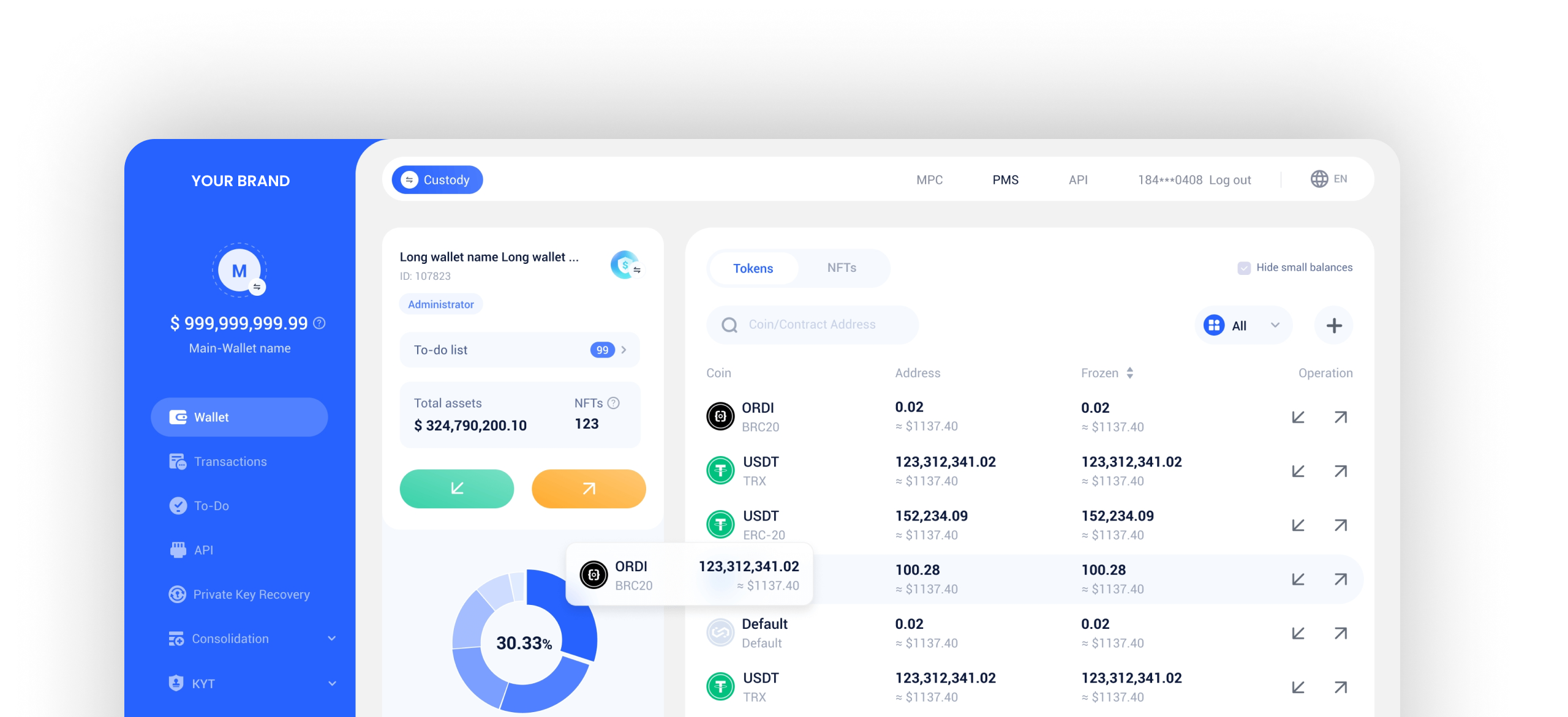
Institutional Custody System
- Cryptographic Engine: Deploys Multi-Party Computation (MPC), Hardware Security Modules (HSMs), or multi-signature setups to eliminate single points of failure by distributing or isolating private key infrastructure.
- Multi-Tiered Governance: Implements Role-Based Access Control (RBAC) and strict approval thresholds, enforcing corporate compliance and quorum requirements before transaction execution.
- Risk Mitigation Engine: Enforces real-time operational safeguards, including address whitelisting and automated transaction throttling, to prevent unauthorized asset movement and minimize capital exposure.
- Continuous Compliance: Integrates automated Anti-Money Laundering (AML) checks and continuous audit logging to ensure instant regulatory visibility and permanent data transparency for reporting.
Far from being a passive storage repository, enterprise custody functions as an active control plane for digital treasury management. Beyond safeguarding raw key material, an enterprise-grade custody infrastructure coordinates several critical operational demands:
- Key Lifecycle Management: Securing key generation, storage, usage, and rotation within isolated, audited environments.
- Granular Governance: Establishing multi-user approval policies that match corporate hierarchies and financial risk tolerances.
- Risk Isolation and Enforcement: Preventing unauthorized asset movement via real-time transaction screening and programmatic compliance controls.
- Regulatory Compliance: Providing clear, automated audit trails and historical transaction logs to simplify regulatory, financial, and third-party accounting audits.
The Structural Imperative for Cryptographic Safeguards
In traditional capital markets, institutional asset safekeeping relies on centralized financial clearinghouses, central securities depositories, and custodian banks. Operational errors or unauthorized transfers within legacy banking rails can be mitigated through commercial litigation, central bank intervention, account freezes, or ledger reversals.
Conversely, public blockchain networks operate under an entirely different structural paradigm:
- Settlement Finality: On-chain transaction execution is mathematically irreversible; there is no centralized authority capable of undoing a validated block entry.
- Intermediary-Free Execution: Networks process transactions based strictly on cryptographic validity rather than account identity, organizational intent, or legal standing.
- Concentrated Vulnerability: Possession of a private key guarantees absolute control over its corresponding on-chain assets, creating an attractive target for external attackers and internal bad actors.
Because blockchain transactions depend entirely on digital signatures generated by private keys, securing these keys is the primary objective of any digital asset custody framework. A lost or compromised key results in permanent, unrecoverable capital loss.
Architecture of an Enterprise-Grade Custody Platform
A professional digital asset custody framework utilizes a multi-layered security model to protect assets while maintaining operational agility:
- Cryptographic Isolation Layer: The core of the platform, where private keys are generated, stored, and verified using advanced cryptographic setups like Hardware Security Modules (HSMs) or Multi-Party Computation (MPC).
- Role-Based Access Control (RBAC): A governance layer that enforces strict separation of duties. It replaces individual private key reliance with structured corporate approval workflows, ensuring no single user can unilaterally move funds.
- Automated Risk Mitigation Engine: A policy layer that continuously screens transactions against predefined criteria, enforcing address whitelisting, velocity limits, and real-time monitoring to block anomalous or high-risk transfers.
- Continuous Compliance and Audit Logging: A ledger system that records all operations, API calls, and policy modifications in a tamper-resistant database, providing a clear audit trail for compliance teams and financial auditors.
Operational Mechanics: Balancing Security and Liquidity
To manage both immediate liquidity needs and long-term capital preservation, institutional platforms combine hot and cold storage configurations into a coordinated treasury framework.
Hot Wallet Environments
Hot wallets maintain active, network-adjacent connections to the internet. They are optimized for real-time transactions, programmatic trading algorithms, automated clearinghouse payouts, and immediate decentralized application (dApp) interactions.
While hot wallets provide excellent operational velocity, their continuous network exposure increases their vulnerability to external cyber threats, memory-dumping malware, and smart contract protocol exploits.
Cold Storage Architectures
Cold wallets operate in completely isolated, air-gapped environments entirely cut off from the internet. Private keys are generated, maintained, and backed up onto offline media or physical security chips that never touch a network interface.
This configuration offers strong protection against remote cyberattacks, making it ideal for securing large corporate reserves, long-term investments, and client deposit assets. However, this high level of security limits transaction velocity, as executing a transfer requires manual approval and physical access to the storage devices.
Coordinated Tiered Treasury Management
To balance security with operational speed, enterprise treasuries use a split-storage architecture that distributes capital based on its intended use:
- Operating Capital (High-Velocity Liquidity): Allocates 5–10% of total assets to network-adjacent hot wallets to support daily operational workflows, exchange transactions, and immediate liquidity demands.
- Core Asset Reserves (Long-Term Preservation): Isolates 90–95% of total assets in air-gapped cold storage systems, leveraging offline environments to eliminate network-facing risks and protect corporate treasury foundations.
This tiered strategy limits risk exposure by keeping the bulk of corporate assets protected in cold storage, while maintaining just enough liquid capital in hot wallets to cover daily operational workflows.
Technical Shift: Multi-Party Computation (MPC)
The integration of Multi-Party Computation (MPC) has fundamentally transformed the digital asset custody landscape, moving the industry beyond traditional single-key and multi-signature models.
Cryptographic Underpinnings of MPC
Traditional custody frameworks rely on a complete, unified private key that must be assembled in a single location to sign transactions, creating a vulnerable single point of failure. MPC eliminates this risk through distributed key generation (DKG) and threshold cryptography.
Under an MPC architecture, a unified private key is never generated or stored anywhere in the system. Instead, the key is created as separate, independent cryptographic shards distributed across an isolated network of participants.
When a transaction is initiated, these separate shards collaborate to produce a valid digital signature through a secure cryptographic protocol. Because the complete private key is never assembled or exposed during this process, attackers cannot compromise the system by targeting a single node.
Strategic Value of MPC for Enterprise Workflows
MPC frameworks provide key operational advantages for institutional token management:
- Elimination of Single Points of Failure: Compromising a single key shard reveals nothing about the master key, preventing isolated server or endpoint breaches from exposing the treasury.
- Blockchain-Agnostic Governance: Multi-signature configurations require specific on-chain smart contract deployments for different blockchains, which can increase implementation costs. In contrast, MPC executes signatures entirely off-chain, providing uniform policy enforcement across all layer-1 and layer-2 networks.
- Dynamic Threshold Adjustments: Organizations can modify approval thresholds and rotate key shards without changing the public deposit address, allowing them to adapt to corporate governance updates without disrupting client-facing operations.
Structural Alignment: Custodial vs. Non-Custodial Models
Institutions can choose between two main custody models, each offering different trade-offs between counterparty risk and operational responsibility:
| Operational Dimension | Custodial Framework (Third-Party Brokerage) | Non-Custodial Framework (Self-Hosted Infrastructure) |
| Private Key Custody | Managed by a regulated, licensed third-party custodian. | Retained internally by the enterprise treasury team. |
| Counterparty Exposure | Dependent on the financial stability and legal structure of the custodian. | Completely eliminated; assets are managed entirely on-chain. |
| Regulatory Validation | Satisfies regulatory requirements for independent, qualified asset safekeeping. | Requires internal compliance tools and forensic tracking to pass audits. |
| Incident Liability | Governed by custodian Service Level Agreements (SLAs) and insurance policies. | Maintained entirely by the operating organization. |
Strategic Trends in Institutional Custody
As digital asset infrastructure evolves, several key trends are shaping the future of institutional custody platforms:
- Context-Aware Automated Risk Mitigation: Platforms are moving past static rule sets toward real-time risk assessment. Modern systems analyze on-chain wallet behavior, transaction velocity, counterparty risk scores, and smart contract execution parameters to automatically identify and block suspicious transfers.
- Unified Web3 Institutional Governance: Custody architectures are expanding beyond basic token storage to support complex on-chain activities. Modern platforms allow enterprises to participate safely in staking, on-chain governance voting, and decentralized finance (DeFi) protocols, applying institutional approval workflows to every interaction.
- Decentralized Identity (DID) Integration: Next-generation custody networks link wallet management directly with enterprise Identity and Access Management (IAM) systems. This ensures that on-chain transaction permissions are tied directly to an employee’s verified corporate identity and role within the organization.
Maximizing Capital Preservation Through Cohesive Architecture
True asset security involves much more than selecting a specific wallet type or storage medium. Comprehensive protection requires a well-structured safety framework that integrates cryptographic keys, institutional user governance, and real-time risk management into a cohesive operational system.
As institutional participation in digital assets expands, professional custody infrastructure has become essential for long-term capital preservation. By implementing modern custody systems—such as advanced MPC frameworks and split cold storage configurations—enterprises can safely navigate the digital asset markets, protect their corporate treasuries, and maintain complete control over their on-chain operations.