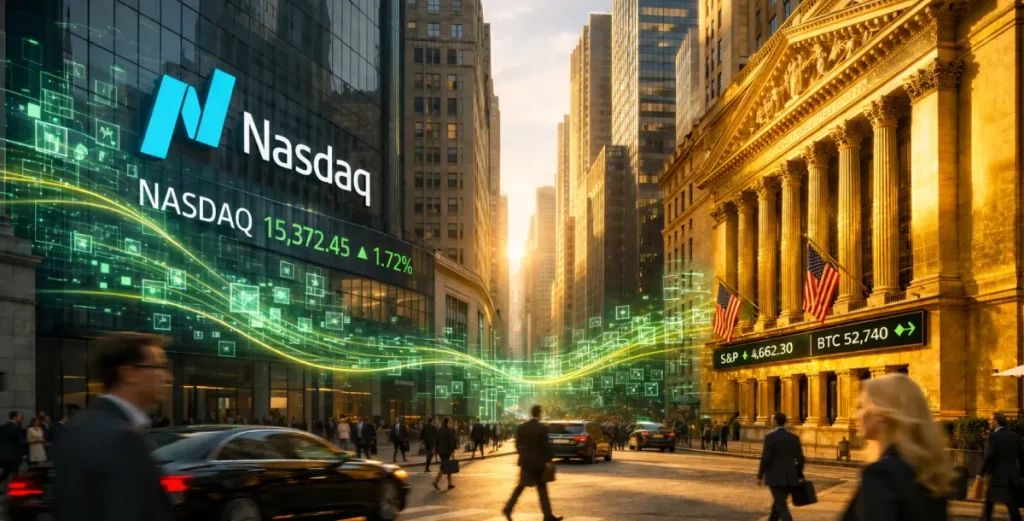

The boundaries between Wall Street and the blockchain are officially dissolving. In a series of landmark moves in early 2026, the U.S. Securities and Exchange Commission (SEC) and the world’s most powerful exchange operators—Nasdaq and Intercontinental Exchange (ICE/NYSE)—unveiled a roadmap to migrate the $126 trillion global equity market to the blockchain.
This isn’t just a technical upgrade; it’s the beginning of a global tokenization revolution. By converting traditional assets into digital tokens, we are moving toward a fundamental reimagining of how value is traded, settled, and stored across the planet.
The “Innovation Exemption”: A Regulatory Launchpad
At the 2026 ETHDenver conference, SEC Chairman Paul Atkins and Commissioner Hester Peirce detailed an “innovation exemption.” This framework acts as a regulated sandbox for the tokenization of Real-World Assets (RWAs), providing the legal clarity needed to move traditional finance onto blockchain rails.
Key pillars of the SEC’s framework include:
- Whitelisted Trading: Using smart contracts to ensure only verified, compliant participants can trade tokens on-chain.
- The “Economic Reality” Rule: A crucial January 2026 clarification established that an asset’s legal status is determined by its economic substance, not whether it exists on a ledger or a piece of paper.
- Measured Growth: Initial volume caps and time-limited exemptions allow the market to test stability without dismantling investor protections.
The “Everything Exchange”: Wall Street’s New Engine
While the SEC provides the rules, Nasdaq and NYSE are building the infrastructure for a unified marketplace where stocks, bonds, and digital assets trade on a shared, 24/7 blockchain infrastructure.
Strategic Alliances Shaking the Market
- Nasdaq & Kraken: Nasdaq is developing an “equity token design” that allows public companies to issue tokenized shares directly on-chain. By partnering with Kraken (Payward), Nasdaq is building a transformation gateway to reach global, crypto-native audiences while preserving CUSIP equivalence.
- ICE (NYSE) & OKX: ICE’s strategic investment in OKX (valuing the platform at $25 billion) aims to bridge NYSE-listed tokenized equities with OKX’s 120 million global users. This partnership leverages OKX’s execution stack to accelerate ICE’s plans for a regulated, on-chain marketplace.
How Tokenization is Changing the World
Beyond the stock market, tokenization represents the birth of the “Internet of Value.” By converting physical and digital assets into programmable tokens, we are removing the “middleman friction” that has slowed global commerce for centuries.
- Fractionalization: Tokenization allows a $100 million skyscraper or a rare piece of art to be broken into thousands of digital shares, making high-value investments accessible to anyone with an internet connection.
- Democratized Access: It bridges the gap between institutional giants and retail traders, offering the same level of transparency and liquidity to everyone.
- Programmable Assets: Imagine a stock that automatically pays dividends the second a company’s earnings hit a threshold, or a real estate token that manages its own rental income via smart contracts.
The Liquidity Glue: Stablecoins & Atomic Settlement
A tokenized economy requires a tokenized dollar. Stablecoins have become the essential bridge between blockchain securities and the real economy.
Traditional trades are often bottlenecked by aging banking wires and multi-day clearing cycles. Tokenization enables Atomic Settlement—where the asset and the payment swap hands simultaneously and instantly. This transforms the financial system from a series of disconnected silos into a seamless, circular digital economy where capital never sits idle.
McKinsey’s Vision: The B2B Tokenization Revolution
The scale of this shift is underscored by recent data from McKinsey & Company, highlighting the $100 trillion+ global B2B payment market as the next major frontier.
According to McKinsey, Business-to-Business (B2B) payments already dominate tokenized value transfer, accounting for $226 billion of the $390 billion in total annualized volume. However, with market penetration at a mere 0.01%, we are only seeing the tip of the iceberg.
By adopting a tokenized blockchain network, corporations can unlock:
- Capital Liberation: Eliminating “trapped liquidity” held in transit within the old banking system.
- Drastic Cost Reduction: Removing intermediary layers to slash transaction fees by up to 70%.
- Efficiency at Scale: Automating complex B2B workflows so payments are released only when smart contract conditions are met.
The Road Ahead: Cost Savings and Market Efficiency
As we look toward formal rulemaking in mid-2026, the primary driver for tokenization is no longer just “innovation”—it is balance-sheet math.
| Feature | Traditional Equities | Tokenized Securities (RWAs) |
| Trading Hours | 9:30 AM – 4:00 PM (EST) | 24/7/365 |
| Settlement | T+1 or T+2 days | Near-Instant (Atomic) |
| Transparency | Centralized Ledger | On-chain, Publicly Verifiable |
| Cost Savings | High Intermediary Fees | Up to 70% Reduction |
By eliminating manual reconciliation and reducing the settlement cycle from T+2 to T+0, institutions can drastically lower their operational overhead. This efficiency democratizes the market, leading to better returns for investors and a more resilient global financial system.
Building the New Foundation of Finance
During the recent SEC discussions, Commissioner Hester Peirce compared the current cautious move toward tokenization to an “abandoned storage unit”—not a monster to be feared, but a resource to be carefully integrated into the financial plumbing.
This incremental shift from the SEC is the green light the market required. For institutions, the focus is now shifting from regulatory theory to operational execution. ChainUp provides the institutional-grade, white-label infrastructure needed to mint, issue, and trade Real-World Assets with full regulatory compliance.
As the mid-2026 rulemaking approaches, the priority is clear: transition from legacy silos to a unified, on-chain ecosystem.
Schedule a consultation with ChainUp’s experts today and lead the $126 trillion transformation.