TL;DR – What you will learn here:
- Which .NET partners have the strongest technical depth, process maturity, and delivery capacity in 2026
- What selection criteria we used (technical skills, Microsoft stack mastery, verified reputation, industry experience, team size)
- At-a-glance comparison of pricing, team size, cloud expertise, and best-fit scenarios
- Which .NET services are actually in demand this year and why the November 2026 end-of-support deadline for .NET 8 & 9 matters
- How .NET powers the backend infrastructure of modern fintech and digital asset platforms
- Practical guidance for CTOs and product owners on choosing a vendor, budgeting, and managing risk
Disclaimer: This article was contributed by an industry expert guest author and does not necessarily reflect the views or opinions of ChainUp.
Introduction
Demand for a dependable .NET development company has never been higher. Two forces are converging in mid-2026: enterprises launching new cloud-native products on .NET 10 and a wave of urgent migrations from .NET 8 and .NET 9 before both versions hit end of support on 10 November 2026. Business leaders therefore need partners who understand the latest framework while still being able to untangle fifteen-year-old code bases.
Overview of the .NET development market in 2026
The current market is shaped by three simultaneous trends.
First, .NET is now fully cross-platform, with Linux hosting representing more than half of new deployments.
Second, the cloud-native layer: .NET Aspire, Azure Functions, and Dapr – has reached mainstream adoption, compressing delivery timelines for microservice architectures.
Third, the approaching end-of-support cliff has a negative impact on budgets: IDC estimates the cost of maintaining end-of-support systems for institutions will increase to $57 billion by 2028, resulting in tremendous opportunity costs and compliance risks as technical debt builds up.
Additional data points help quantify the opportunity: Stack Overflow confirms over 25% of global developers use modern .NET;
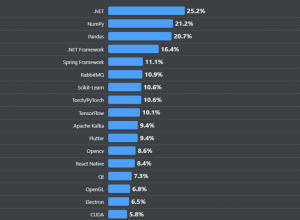
TechEmpower benchmarks place ASP.NET Core neck-and-neck with Go and Rust in raw API throughput, demonstrating Microsoft’s flagship web stack is no longer a “safe but slow” option. Finally, because Microsoft’s revised policy forces .NET 8 and 9 to share a November 2026 expiration, HeroDevs warns that migrating to .NET 10 is the only path to securing three years of support.
Why businesses choose Microsoft .NET for custom software development
Decision makers gravitate toward .NET because it combines performance with predictable governance. Built-in security APIs, strong type safety, and mature tooling reduce audit effort in regulated spaces. For example, ASP.NET Core automatically protects against cross-site request forgery and encodes server-side output by default to reduce script injection vulnerabilities. The platform’s language evolution also keeps teams productive – C# 14’s new field keyword, extension members, and implicit span conversions eliminate boilerplate code in line-of-business projects.
Why .NET Matters in Crypto and FinTech
The NET technology is widely used in enterprise software. But financial services and digital asset infrastructure deserve special attention. Pay gateways require sub-millisecond response time under concurrent load. Exchange backends are expected to process thousands of orders per second with strict auditability. Custody systems have to enforce cryptographic controls but cannot afford to slow settlement. .NET’s architecture directly addresses each of these constraints.
The opportunity is obvious. 87% of financial institutions will use blockchain or related technologies to reduce operational friction by mid-2025. Stablecoins processed over $8.9 trillion in volume in just the first half of 2025, and tokenized real-world assets on public and permissioned chains crossed $36 billion. This is production-grade financial plumbing now and .NET is one of the primary back-end stacks powering it. The specific capabilities driving that adoption include:
- High throughput under concurrent load. ASP.NET Core’s async-first model handles simultaneous wallet queries, payment processor calls, and blockchain node interactions without thread-pool saturation
- Compliance-ready security primitives. Built-in OAuth2 with PKCE, Azure Active Directory integration, and data protection APIs that meet PCI-DSS, PSD2 and MiCA requirements, without custom implementations.
- Distributed transaction support. Audit-grade telemetry Entity Framework Core handles financial operations that span multiple databases or microservices, where partial commits pose regulatory and reputational risk.
- Audit-grade telemetry. OpenTelemetry exporters and structured logging pipelines must meet the traceability standards required by SOC 2, ISO 27001, and US, EU, and APAC financial regulators.
- Enterprise integration maturity. gRPC bridges, Azure Service Bus patterns, and SWIFT/SEPA connector libraries let teams wire .NET services into existing core banking infrastructure without rebuilding the integration layer from scratch
Blockchain Development with .NET
The .NET ecosystem’s adoption in enterprise blockchain development has accelerated in the past two years, driven by structural advantages that matter specifically in regulated financial contexts.
High-Performance APIs for On-Chain Interaction
The minimal API surface refined in .NET 10 suits the low-latency demands of blockchain backends. In a normal development environment, teams use .NET along with Nethereum, the #1 .NET ethereum library to query on-chain state, encode smart contract calls and process EVM events. ASP.NET Core’s async-first approach and middleware-level caching means APIs can handle the concurrent load generated by digital asset exchanges and custody systems.
Cross-Platform Infrastructure Compatibility
Modern blockchain back ends run on Linux in containerized environments. .NET’s full cross-platform support means a .NET 10 microservice handling wallet operations runs identically on Azure Kubernetes Service, AWS EKS, or an on-premises cluster – important for institutions with data residency requirements or hybrid cloud mandates.
Security and Compliance by Design
The blockchain infrastructure for financial institutions will have to comply with AML, KYC, and KYT (Know Your Transaction) requirements being codified by regulators across the US, EU, and APAC in 2026. .NET’s crypto libraries, Azure Key Vault integration, and certificate management capabilities help reduce implementation errors in sensitive operations such as transaction signing and private key lifecycle management.
Integration with Banking and Financial Systems
Institutions entering the digital asset space still run core banking systems on legacy infrastructure. .NET’s gRPC bridges, message-bus patterns via Azure Service Bus or MassTransit, and WCF migration tooling let development teams connect blockchain components to existing SWIFT, SEPA, and treasury management systems without rebuilding the integration layer from scratch.
The Core Architectural Dilemma: Build vs. Buy
For CTOs mapping out a digital asset roadmap, a critical architectural fork emerges: Do you task your .NET team with building complex cryptographic and compliance layers from scratch, or do you deploy production-ready infrastructure via API?
General-purpose .NET vendors excel at business logic, system integration, and custom workflows. However, specialized layers, like institutional custody, secure multi-party computation (MPC), and real-time transaction monitoring, require highly niche cryptographic engineering.
This is where web3 infrastructure specialists complement traditional development squads. For instance, integrating ChainUp’s institutional-grade MPC custody infrastructure or white-label exchange technology allows your internal .NET developers to focus on proprietary features, front-end optimization, and core business logic, rather than spending years reinventing the wheel on foundational digital asset plumbing.
How we selected the companies in this ranking
Our longlist started with 40 Microsoft .NET development companies that appeared across analyst reports, Clutch listings, and Microsoft partner directories. We then applied five weighted criteria:
- Documented technical depth in at least three .NET generations
- Hands-on Microsoft stack experience: Azure, Power BI, and Active Directory
- Client reputation validated through ≥ 10 public reviews averaging ≥ 4.7
- Industry expertise within at least one compliance-heavy vertical
- Delivery capacity: the ability to staff cross-functional teams within four weeks
Each remaining vendor was interviewed about their most challenging recent .NET program. Only those who could share quantified outcomes – performance, cost, or user impact – were shortlisted.
How We Ranked the Best .NET Development Companies
Every CTO reading a “top .NET development companies 2026” list has one key concern: will this partner keep my roadmap on track through 2027? The mechanics of our evaluation, therefore, go beyond marketing sites.
Before diving into the sub-criteria, it’s worth stating our underlying assumption: good engineering is visible in delivery artifacts – architecture decisions, test coverage reports, and production metrics – not in pitch decks. During reference calls, we ask former clients for raw numbers: latency, availability, and release frequency. Vendors that could not produce hard data were excluded.
1) Technical Expertise
Depth shows when engineers can discuss quirks of every framework version. For instance, knowing why a WCF service breaks when migrating to gRPC Gateway in .NET 10, because duplex callbacks need a different pattern, separates solid .NET developer companies from generic full-stack labs. We also examined repositories (when public) for adherence to best practices: nullable reference types enabled, asynchronous streams instead of legacy async void patterns, and modern analyzers such as Roslynator integrated into CI.
2) Microsoft Technology Stack Experience
Azure proficiency must reach beyond “we host on App Service.” We asked for examples that combined Service Bus with Azure Functions durable patterns or Cosmos DB with multi-region writes. Where possible, we cross-checked partner designations – Data & AI, Digital & App Innovation – with Microsoft Partner Center. AWS capability is valuable when enterprises need architectural hedging, but we prioritized Azure because 72% of .NET workloads still land there first.
3) Client Reviews and Reputation
Average scores alone are misleading: five-star ratings can mask shallow engagements. We inspected review narratives for concrete outcomes. A reputable partner’s client typically states, “API response time dropped from 220 ms to 40 ms, and we cut EC2 spend by 28%,” not simply “they delivered on time.” Long relationships were weighted heavily if 60% of clients stayed longer than five years; their products evidently withstood production pressures.
4) Industry Expertise
Compliance shapes source code. A fintech microservice must support compensating transactions for rollbacks, whereas a healthcare API often embeds PHI encryption at rest. When a vendor cites HIPAA or PCI-DSS, we request specifics: did they implement database encryption with Always Encrypted or tokenization? Vendors able to cite concrete mitigation strategies, not just buzzwords, scored higher.
5) Team Size and Delivery Capacity
Numbers matter, but context matters more. A 3,000-engineer consultancy can still experience talent shortages if only 2% of its pool is seasoned .NET architects. We therefore asked for ratio metrics: seniors-to-total, attrition rates, and bench capacity. Average staffing lead time across shortlisted top .NET development services companies is 19 days from contract signature to first sprint, an operational metric important for program scheduling.
Best .NET Development Companies
Below you will find expanded, in-depth profiles. Each description now goes deeper into technical stories and measured business outcomes.
1. Techstack
Techstack is a strategic technology partner for companies modernizing legacy .NET systems and building secure, cloud-ready .NET products. Headquartered in Wrocław, Poland, the company is ISO 27001 and 27701 certified, and its QA engineers hold individual ISTQB certifications. Its developers work in senior, long-term teams rather than rotating contractors, a meaningful distinction in a region where senior .NET talent is aggressively poached. Its case studies anchor heavily in regulated, legacy-heavy industries like healthcare and fintech, though its client roster also spans SaaS, logistics, retail, and manufacturing.
For context, Techstack’s modernization engagements routinely involve the parallel operation of old and new .NET versions: .NET Framework 4.x modules sitting beside containerized ASP.NET Core microservices – a scenario where orchestration mistakes compromise uptime.
Key .NET Development Services
- Legacy migration from ASP.NET MVC, WCF, and Windows Services to modern .NET, up to .NET 10, moving toward API-first architecture
- Multitenant SaaS re-platforming built around a hybrid tenancy model – shared infrastructure by default, with dedicated resources available as a premium tier
- Performance & cost optimisation: moving monoliths to serverless architecture on AWS and Azure, with controlled rollout practices to reduce delivery risk
- Dedicated modernisation squads that bring backend engineers, DevOps and cloud specialists, and QA automation together
Industries Served:
Fintech, healthcare, SaaS, logistics, retail, manufacturing.
Why Choose This Company
Techstack case studies illustrate tangible ROI. A US FinTech financial planning client eliminated their costly one-server-per-client infrastructure model and achieved 30% faster development and releases after Techstack rebuilt the platform on .NET 6 with a modern multitenant architecture. Another such project was an AI face-matching platform for mass events where Techstack refactored the monolith to serverless and reduced the server cost by 50%. It’s worth noting that 60% of their clients have been partnered for over five years, which says a lot about deliverables that have stuck with them as the regulatory landscape changed.
2. ScienceSoft
Founded in 1989, ScienceSoft predates .NET itself, giving the company a long memory of enterprise architecture evolution. With 750+ specialists and dual headquarters in the US and Eastern Europe, ScienceSoft operates more like an engineering advisory firm than a code factory. The firm’s Architecture & Solutions Center of Excellence reviews every client design to enforce alignment with ISO 9001 processes.
Key .NET Development Services
- Architect-led re-engineering of monolithic ERP solutions into modular, API-first back ends
- Azure microservices with automated Blue/Green deployments via Azure DevOps
- 24/7 application support through follow-the-sun teams in three continents
- Compliance consulting paired with technical remediation (SOC 2, HIPAA, PCI-DSS)
Industries Served:
Banking, retail, healthcare, telecom, professional services.
Why Choose This Company
Large enterprises value predictable process depth. For example, ScienceSoft led a 25-year-old desktop wealth-management suite’s transformation into a web-based SaaS while maintaining zero downtime. The vendor’s mature PMO calculates Earned Value at every milestone, feeding management-level dashboards – this governance apparatus is why procurement officers shortlist ScienceSoft for mission-critical rebuilds.
3. ELEKS
ELEKS, founded in 1991, now spans three continents with 2,000+ engineers. While many best .NET development company advertise AI capabilities, ELEKS has a dedicated data science practice recognized by Forrester. That matters when modernizing .NET back ends that feed ML pipelines.
Key .NET Development Services
- Event-sourced architectures for high-volume telemetry, underpinned by Azure IoT Hub
- Predictive modelling integration via ML.NET and ONNX runtime wrappers
- GPU-accelerated calculations in finance and logistics using C# interop with CUDA libraries
- Security-hardened cloud deployments featuring managed identities and Key Vault rotation
Industries Served:
Energy, government, logistics, automotive, fintech.
Why Choose This Company
A European energy company required real-time load balancing, and ELEKS provided it: a .NET 10 gRPC backend data ingestion of millions of sensor points per minute with ML-driven demand forecasts. This achieved an independently audited 99.998% uptime. For companies with data science and .NET converging, ELEKS shortens the road from analytical model to production.
4. Intellias
With 3,300 employees and roots in automotive and fintech, Intellias marries domain knowledge with engineering capacity. The firm’s IDEAbook, an internal blueprint library codifies patterns like event-driven banking ledgers and over-the-air car firmware update pipelines, accelerating greenfield builds.
Key .NET Development Services
- Payment-grade microservices compliant with PSD2 and PCI-DSS
- Connected vehicle platforms using .NET 10 minimal APIs for low-latency telematics
- Real-time analytics via Azure Stream Analytics integrated into .NET processing stages
- Cloud cost governance leveraging FinOps dashboards built on Power BI
Industries Served:
Fintech, automotive, telecom, EdTech.
Why Choose This Company
A tier-one European bank moved its core wallet service to Intellias. Within nine months, daily user concurrency rose from 60,000 to 1.4 million without latency spikes. That scale arrived at 27% lower cloud spend thanks to per-call cost tracing baked into the pipeline. Where regulatory fintech intersects with performance, Intellias is often the best .NET development company.
5. Innowise Group
Innowise Group’s differentiator is operational elasticity. ISO 9001/27001/27017/27018 compliance, plus a 3000-person roster, lets them spin up a 15-engineer squad, including QA automation and DevOps, in under three weeks. Eastern European delivery centers overlap Western business hours, easing communication.
Key .NET Development Services
- Dedicated team augmentation with a clear SLA on team ramp-up and knowledge transfer
- Greenfield product delivery on .NET 10 & Azure Kubernetes Service
- AWS-first serverless .NET APIs for companies avoiding cloud vendor lock-in
- QA automation coverage expansion, often starting from sub-50% to 85%+
Industries Served:
Finance, healthcare, manufacturing, logistics, e-commerce.
Why Choose This Company
An eCommerce marketplace in Germany went from 4 to 18. However, Innowise experts applied NET modules to this system and demonstrated a 40% increase in feature throughput without any additional PM overhead. For CTOs under board pressure to “find more engineers tomorrow,” Innowise Group offers reliable capacity without the bureaucracy of mega-consultancies.
6. Andersen
Andersen maintains 3,500 specialists across North America and Europe. Their model emphasizes embedded senior developers who adopt client ceremonies – Scrum, Kanban, SAFe – rather than imposing a vendor framework. Attrition remains under 10%, giving long-running augmentation teams knowledge continuity.
Key .NET Development Services
- Enterprise portal extensions on Sitecore and Umbraco for B2B firms
- API integrations with legacy CRM/ERP via .NET 10 gRPC bridges
- Long-term staff augmentation in squads of 2-20 developers
- Manual-to-automated QA conversion using Playwright on Blazor UIs
Industries Served:
Banking, insurance, logistics, retail.
Why Choose This Company
One US insurer embedded 12 Andersen seniors to rebuild claims handling. Velocity climbed 33% without hiring permanent staff. If you own architecture internally and need execution muscle, Andersen delivers.
7. DataArt
DataArt grew from a Wall Street systems integrator into a 6,000-consultant global partner. Financial DNA still guides its .NET practice: every service is designed for auditability, idempotency, and failure isolation.
Key .NET Development Services
- High-throughput event buses using Azure Service Bus Topics + Cosmos DB change-feed
- Legacy FIX/Swift integration cutover into RESTful microservices
- Hospitality integrations – PMS, CRS – behind unified .NET façade
- Zero-downtime deployments via automated canary and smoke tests
Industries Served:
Fintech, hospitality tech, healthcare, media.
Why Choose This Company
A global hotel brand used DataArt to re-engineer its booking engine. Booking response time dropped from 3.2 s to 480 ms, leading to a 6.1% uplift in conversion. DataArt’s edge is marrying complex protocols with stable .NET code.
8. Sigma Software
Sigma Software combines Swedish corporate governance with Ukrainian engineering depth (2,000 staff). The firm’s heritage in defense simulation and automotive shows in its obsession with deterministic behaviour – ideal for .NET desktop development companies tackling high-precision tasks.
Key .NET Development Services
- Embedded-system back ends interfacing with CAN bus or OPC UA data streams
- WPF-based control panels for industrial equipment with real-time telemetry
- Azure DevOps pipelines enforced by gated code coverage policies at 90%+
- Security reviews using threat modelling workshops per OWASP SAMM
Industries Served:
Automotive, aerospace, public sector, enterprise utilities.
Why Choose This Company
An EU defense contractor needed a cross-platform simulation orchestrator. Sigma Software delivered deterministic physics loops in C# 14 that tolerated 50 ms latency variance without drift – critical for pilot training accuracy.
9. Ciklum
Ciklum, with 4,000 professionals, straddles staff augmentation and full solution build. Recent acquisitions have added design studios and data teams, letting Ciklum offer end-to-end digital transformation centered around .NET microservices.
Key .NET Development Services
- Omnichannel retail back ends with headless commerce architecture
- Monolith decomposition into Kubernetes-hosted ASP.NET Core services
- Cross-platform mobile via .NET MAUI for unified code sharing
- Data engineering tying Synapse Analytics into .NET ETL pipelines
Industries Served:
Retail, healthcare, finance, digital media.
Why Choose This Company
A UK supermarket chain migrated a 15-year monolith to microservices with Ciklum’s 20-developer squad. Release cadence moved from quarterly to fortnightly; checkout abandonment fell 4.7% due to faster basket APIs.
10. Cleveroad
With 250 specialists, Cleveroad delivers enterprise-grade discipline to mid-market budgets. The Estonia-headquartered firm publishes strict estimation and change-control processes, which is why small-to-medium organizations trust them for fixed-budget delivery.
Key .NET Development Services
- Logistics platforms with real-time route optimisation
- Healthcare portals using FHIR-compliant APIs built on ASP.NET Core
- Desktop utility modernisation from .NET Framework 3.5 to .NET 10 MAUI
- Full regression automation via BDD-level Gherkin tests
Industries Served:
Logistics, transportation, healthcare, mid-market SaaS.
Why Choose This Company
A Nordic logistics provider moved its dispatch board to MAUI. Cleveroad hit an 180-day timeline, and driver satisfaction scores rose 18% due to offline-first mobile capability. For tightly scoped 3-18 month projects, Cleveroad often emerges as one of the best .NET development services companies.
Comparison of Top .NET Development Companies
| Company | HQ | Team Size | Typical Rate | Primary Strength | Senior Ramp Time | Clouds Supported |
|---|---|---|---|---|---|---|
| Techstack | Poland | 200+ | $45–70/hr | Legacy modernization, regulated domains | 2–3 weeks | Azure, AWS, GCP |
| ScienceSoft | USA / EE | 750+ | $50–99/hr | Consulting-led enterprise programs | 3–4 weeks | Azure, AWS, GCP |
| ELEKS | Ukraine / EU | 2,000+ | $45–75/hr | Data-driven platforms | 3 weeks | Azure, AWS, GCP |
| Intellias | Malta / EU | 3,300+ | $45–80/hr | Fintech & mobility | 2–3 weeks | Azure, AWS, GCP |
| Innovise Group | Poland / EU | 3,000+ | $40–75/hr | Fast team scaling | 2 weeks | Azure, AWS, GCP |
| Andersen | US / EU | 3,500+ | $40–80/hr | Staff augmentation | 2–4 weeks | Azure, AWS, GCP |
| DataArt | US / EU | 6,000+ | $50–90/hr | Complex integrations | 3 weeks | Azure, AWS, GCP |
| Sigma Software | Sweden / UA | 2,000+ | $40–70/hr | Performance-critical systems | 2–3 weeks | Azure, AWS |
| Ciklum | UK / UA | 4,000+ | $45–80/hr | Enterprise-scale programs | 3–4 weeks | Azure, AWS, GCP |
| Cleveroad | Estonia / UA | 250+ | $35–65/hr | Mid-market logistics & healthcare | 2 weeks | Azure, AWS |
What Services Do .NET Development Companies Provide?
Selecting among top .NET development companies and developers requires clarity on service types. Without it, RFPs balloon with irrelevant scope.
Custom .NET Software Development
Comprehensive engagements start at discovery workshops where architects model domains in Event Storming sessions. These outputs are a bounded context map, a prioritized backlog, and a user-story set ready for a sprint. Implementation covers API layers and domain services as well as Blazor or React + REST UIs. The “shift-left” mantra is followed with test stages: unit tests, mutation tests, and contract tests are completed in CI before QA receives a build.
ASP.NET Core Development
ASP.NET Core underpins modern web stacks. Mature vendors optimize middleware chains, configure YARP for reverse proxying, and embed diagnostics via Open Telemetry exporters. They implement OAuth2 flows with Proof Key for Code Exchange (PKCE) in regulated finance to be compliant with PSD2 SCA requirements. Teams profile allocations in dotMemory and fill the holes with pooling libraries such as ArrayPool.
Enterprise Application Development
Enterprise back ends differ from SaaS startups by needing multi-module identity management, granular auditing, and external system orchestration. Good .NET software development companies enforce CQRS & event sourcing for traceability. These domain events are used to power Power BI dashboards, which are then used for near-real-time KPI monitoring with no dev intervention.
Cloud and Azure Solutions
Azure remains the canonical environment for .NET workloads. Mature partners design landing zones with policy assignments, network peering, and workload identities pre-configured. They use Bicep or Terraform to deploy infrastructure as code and have auto-applied guardrails that stop privileged ports being opened or resources from being tagged in pull requests. AWS deployment scripts are similar to Azure resource groups in multi-cloud strategies to provide exit strategy parity.
.NET Desktop Application Development
Although the web gets the headlines, .NET desktop development companies still handle WPF/WinForms refresh cycles and new .NET MAUI apps. Use cases include radiology workstations requiring DICOM viewers or manufacturing HMIs that need offline mode and PLC integrations. Professional selling considers the limitations of GPU texture memory, hardware acceleration (SharpDX), and input lag.
Blockchain Development with .NET
Enterprise blockchain development is an area where .NET’s strengths converge in a meaningful way. Regulated financial institutions building digital asset platforms, whether for tokenized securities, payment stablecoin infrastructure, or institutional custody, need a back-end stack with proven cryptographic libraries, compliance-grade logging, and the ability to connect to existing financial systems via well-documented integration patterns. .NET provides all three.
In practice, .NET teams building blockchain-adjacent products use Nethereum to interact with Ethereum and EVM-compatible chains, implement transaction monitoring pipelines as ASP.NET Core background services, and handle webhook callbacks from KYT providers through standard middleware patterns. The same Azure Key Vault integration used for database encryption in a traditional fintech application also handles HSM-backed key storage for wallet operations. This overlap between conventional fintech engineering and blockchain infrastructure is where .NET development firms with deep financial services backgrounds add the most value.
Strategic Architecture Tip: While a top-tier .NET development partner can effortlessly build your application layer, middleware, and API endpoints, forcing them to architect proprietary cryptographic custody or matching engines introduces substantial timeline risk and security overhead.
As an infrastructure provider, ChainUp frequently acts as the underlying engine for these development teams. By exposing robust APIs and SDKs that slot directly into modern .NET Core microservices, we handle the institutional-grade compliance (MiCA/PCI-DSS), tokenization frameworks, and MPC wallet security, while your chosen .NET partner focuses on building your unique user experience.
Legacy System Modernization
Modernization is often phased:
- Assessment: Dependency graph, static code analysis and cyclomatic complexity scoring.
- Strangulation: New .NET 10 microservices intercept the traffic, and the traffic can be phased out over time.
- Data migration: ETL or incremental CDC (Change Data Capture) with bulk copy.
- Validation: Parallel run, including shadowing and automated comparison of transactional outputs.
A cutover leaving with one is a dangerous situation. Phased rollout with feature flags is giving options to roll back.
Application Migration to .NET
Companies move away from PHP, Java EE, or Python. Benefits of Azure alignment and type safety outweigh rewrite costs. Successful partners use side-by-side benchmarks: the same endpoints are served by old and new stacks using Gatling or k6. Results guide tuning: thread-pool starvation issues, allocation spikes, or garbage-collection configuration. Migration engagements conclude with user acceptance training and a day 2 operations playbook.
See the timeline below for a sense of the urgency of migration:
| .NET Release | Support End Date | Typical Action in 2026 |
| .NET Framework 4.8 | April 2029 | Begin phased strangulation |
| .NET 6 (LTS) | November 2024 | Already EOL – urgent upgrade |
| .NET 8 (STS) | November 2026 | Plan upgrade by Q3 2026 |
| .NET 9 (STS) | November 2026 | Same deadline – parallel pressure |
| .NET 10 (LTS) | November 2028 | Target platform for new builds |
This table explains why the market for top .NET development companies 2026 is so hot: two releases run out of time simultaneously, overlapping framework backlogs.
How to Choose the Best .NET Development Company
Choosing a vendor is part technical diligence, part organizational fit. Start with a discovery call where you talk about business objectives in plain English. Observe whether the vendor’s questions focus on outcomes (KPIs, user impact) rather than technologies alone. After that call, run through a structured checklist:
- Does the RFP response include a system-context diagram and risk log?
- What percentage of proposed engineers are senior (7+ years) versus mid-level?
- How does the vendor approach security baselining – static analysis, dependency scanning?
- Can they demonstrate their CI/CD pipeline on a sample repo?
- Is QA automation first-class from sprint 1 rather than deferred?
- Will you have direct Slack/Teams access to developers or funnelled communication?
- Does the vendor have experience with payment compliance frameworks such as PCI-DSS or PSD2, and can they speak credibly to the boundary between custom development work and third-party infrastructure like custody or exchange platforms?
Remember to look beyond rate cards. A $50/hr vendor who needs 12 months to deliver may cost more than a $70/hr vendor with stronger reuse libraries and architectural accelerators. Conduct a small paid pilot, perhaps a 2-sprint prototype, to validate working chemistry before committing to a 12-month scope.
Benefits of Hiring a Dedicated .NET Development Company
The right partner lets you sidestep the hidden costs of internal hiring – recruiter fees, notice periods, and onboarding drag. More importantly, mature top .NET development companies and developers bring institutional knowledge gained across dozens of similar migrations. Consider the operational advantages:
- Acceleration. Pre-baked infrastructure templates, domain libraries, and test harnesses cut ramp-up time.
- Risk reduction. Regression suites often hit 90% coverage, guarding against silent data corruption during migration.
- Elastic capacity. Scale teams up during a high-risk migration sprint, then downshift to a maintenance crew.
- Cross-disciplinary access. Need a security champion or FinOps analyst? They are likely one Slack ping away inside the same vendor.
At the executive level, outsourcing converts capex into opex, smoothing P&L volatility, a non-trivial benefit for public companies under quarterly scrutiny.
Why Businesses Continue Choosing Microsoft .NET in 2026
The strategic calculus is straightforward: bet on a platform supported by a trillion-dollar vendor that delivers predictable LTS releases and maintains backward compatibility. Performance keeps improving – .NET 10 brings vectorization, string search and dynamic PGO, while .NET 11 previews runtime-level async, Zstandard compression, and WebAssembly AOT. Semantic Kernel means generative AI features, chat summarization, and retrieval-augmented search can be folded into existing controllers with minimal boilerplate code. C-suite stakeholders understand these features are delivered via an in-place upgrade, not a rewrite of requirements.
Enterprises also value ecosystem integration. Active Directory credential flow, Power BI analytics, and Microsoft 365 connectivity share authentication tokens seamlessly in a .NET stack. CIOs weighed down by audit obligations lean toward fewer moving parts, and .NET gives them a single throat to choke.
Finally, talent supply remains strong. Eastern Europe, particularly Poland and Ukraine, graduates over 5,000 new .NET engineers annually, according to European Software Skills Alliance data. That labor pool keeps hourly rates in the $45-$80 range even as global demand spikes, making dedicated .NET developer companies financially attractive.
FAQs
What is the best .NET development company in 2026?
No “one size fits all” champion. Techstack is distinguished in complex legacy modernization. ScienceSoft thrives where governance is key. Intellias is at the forefront in terms of fintech scale.
How much does it cost to hire a .NET development company?
Rates in the East range from $35 to $80 per hour and the West from $100 to $200 per hour. If you want to do a targeted legacy module migration, it could range between $40K and $150K. A full mid-market SaaS rebuild could come to $300K-$600K; enterprise multi-year programs can go over $1M.
Are .NET desktop development companies still relevant in 2026?
Absolutely. Healthcare imaging, industrial controls, and offline-first field apps still demand native desktop or MAUI front ends with hardware acceleration and local data stores.
Can a .NET development company migrate legacy applications?
Yes. The busiest service line this year is migrations. Competent vendors operate parallel environments, have automated regression built in, and plan incremental cut-overs prior to the November 2026 EOL date.