With the maturation of blockchain technology and Decentralized Finance (DeFi), users are increasingly prioritizing the security and autonomy of their digital assets. In traditional fintech, users rely on centralized intermediaries to safeguard their funds. However, in the blockchain paradigm, total control shifts to the individual. In this landscape, non-custodial wallets have emerged as the premier tool for asset management, with the private key serving as the foundational element of the entire security architecture.
Understanding the interplay between non-custodial wallets and private keys is essential for anyone entering the digital asset space. This guide explores the technical mechanics, security protocols, and best practices required to establish a robust self-custody framework.
1. Defining the Non-Custodial Wallet
1.1 The Core Concept
A non-custodial wallet (also known as a self-custody wallet) is a tool that grants the user exclusive control over their private keys. Unlike centralized services, the wallet provider neither stores your keys nor possesses the technical ability to access your funds.
In a non-custodial framework:
- Exclusive Ownership: Only the user holds the private keys.
- On-Chain Settlement: Assets reside directly on the blockchain; the wallet is merely an interface to interact with them.
- Zero Intermediary Risk: No third party can freeze, censor, or move your assets.
This model is the purest expression of blockchain’s “decentralized” ethos—eliminating the need for permission from a central authority.
1.2 Non-Custodial vs. Custodial: The Critical Divide
The digital asset world is split into two distinct categories:
- Custodial Wallets: Managed by a third party (e.g., a centralized exchange like Coinbase or Binance). You log in with a username and password, but the institution holds the keys. This requires high levels of trust in the provider.
- Non-Custodial Wallets: You manage the keys yourself. No institution can intervene.
The Golden Rule of Crypto: “Not your keys, not your coins.” If you hold the private key, you use a non-custodial wallet. If a third party holds it, the wallet is custodial.
2. The Power of the Private Key
2.1 What is a Private Key?
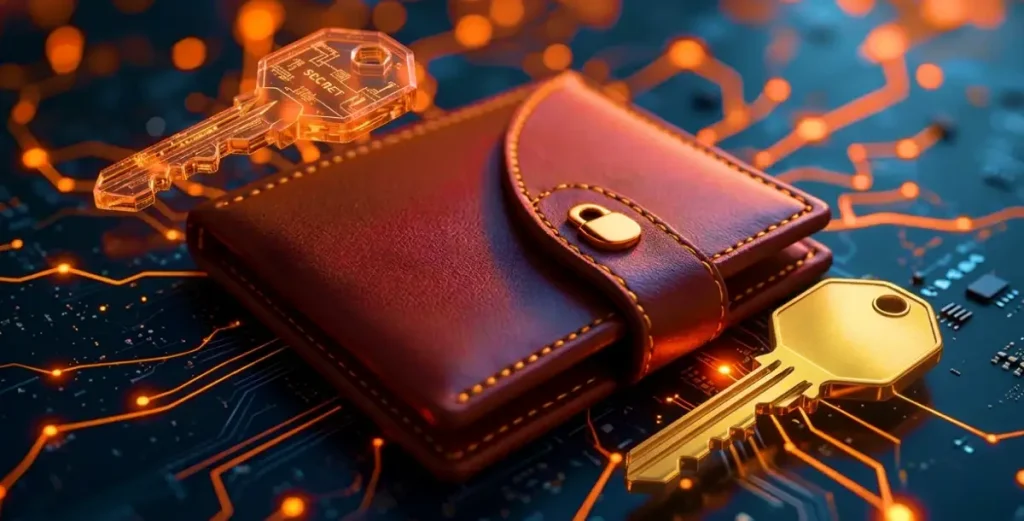
A private key is a sophisticated cryptographic proof—essentially a unique hexadecimal string—that functions as the ultimate “digital signature” for blockchain assets. It is mathematically linked to your wallet address through asymmetrical cryptography.
In the blockchain ecosystem:
- Authorization: The private key signs and validates every transaction.
- Proof of Ownership: It is the only way to prove you own the assets at a specific address.
- Unrivaled Authority: Anyone with access to the private key has total, irrevocable control over the associated funds.
2.2 The Key-Address Relationship
The relationship between keys follows a one-way mathematical path:
- Private Key: The root of all authority.
- Public Key: Derived from the private key via an elliptic curve algorithm.
- Wallet Address: A hashed version of the public key, used to receive funds.
As this math is one-way, you can safely share your address to receive payments, but your private key must remain hidden to protect the source of power.
3. How Non-Custodial Wallets Function
The primary role of a non-custodial wallet is to help users manage their private keys securely while facilitating transaction signing.
The Transaction Lifecycle:
- Initiation: The user prepares a transaction within the wallet interface.
- Local Signing: The wallet uses the private key to generate a cryptographic signature.
- Broadcasting: The signed (authorized) transaction is sent to the blockchain network.
- Verification: Nodes confirm the signature’s validity against the public key.
- Settlement: The transaction is permanently recorded on the ledger.
Crucially, the private key never leaves the local device during this process, ensuring that the authorization remains in the user’s hands.
4. Why Choose Self-Custody?
- Absolute Sovereignty: You are your own bank. You are not at the mercy of a centralized platform’s solvency or terms of service.
- Privacy-First: Non-custodial wallets rarely require “Know Your Customer” (KYC) documentation, allowing for pseudonymous financial management.
- Resilience: Even if the wallet developer goes bankrupt or their website goes down, your assets remain accessible via any other compatible wallet interface using your recovery phrase.
- Censorship Resistance: Your funds cannot be frozen by a central entity, making self-custody a vital tool for financial freedom.
5. The Risks of “Being Your Own Bank”
With total control comes total responsibility. Self-custody introduces specific risks:
- Irretrievability: There is no “Forgot Password” button. If you lose your private key or recovery phrase, the assets are lost forever.
- Instant Exfiltration: If a key is leaked or phished, an attacker can drain the wallet instantly. Blockchain transactions are irreversible.
- Malware & Phishing: Sophisticated “drainer” scripts and malicious dApps can trick users into signing away their permissions.
6. Security Best Practices for Self-Custody
To mitigate these risks, professional users employ a multi-layered security protocol:
- Offline Backups: Store your recovery phrase (mnemonic) on physical media—ideally a metal backup—and keep it in a secure, fireproof location.
- Air-Gapped Interaction: For significant holdings, use a hardware wallet to ensure the private key stays offline.
- Tiered Asset Management:
- Cold Storage: For long-term reserves (rarely touched).
- Hot Wallet: For daily DeFi interactions (minimal funds).
- Trading Wallet: Dedicated specifically for exchange transfers.
- Regular Audits: Use tools to revoke “Smart Contract Allowances” periodically to ensure old dApps no longer have permission to move your tokens.
7. The Future of Keys and Wallets
As we look toward the future of Web3, the industry is moving toward making self-custody more accessible without sacrificing security.
- Account Abstraction (ERC-4337): Allows for “Smart Contract Wallets” that can support social recovery and daily spending limits.
- MPC (Multi-Party Computation): Replaces a single private key with multiple “secret shares,” eliminating the single point of failure.
- Decentralized Identity: Your wallet address will increasingly serve as your global login and reputation score across the decentralized web.
In the blockchain era, the private key is the ultimate anchor of security, and the non-custodial wallet is the essential tool for wielding that power.
Choosing self-custody is a commitment to financial autonomy. While it requires a higher level of technical vigilance, it is the only way to truly “own” your digital wealth in the Web3 ecosystem. By mastering the management of your private keys and adopting a disciplined security perimeter, you can navigate the decentralized world with confidence and total control.