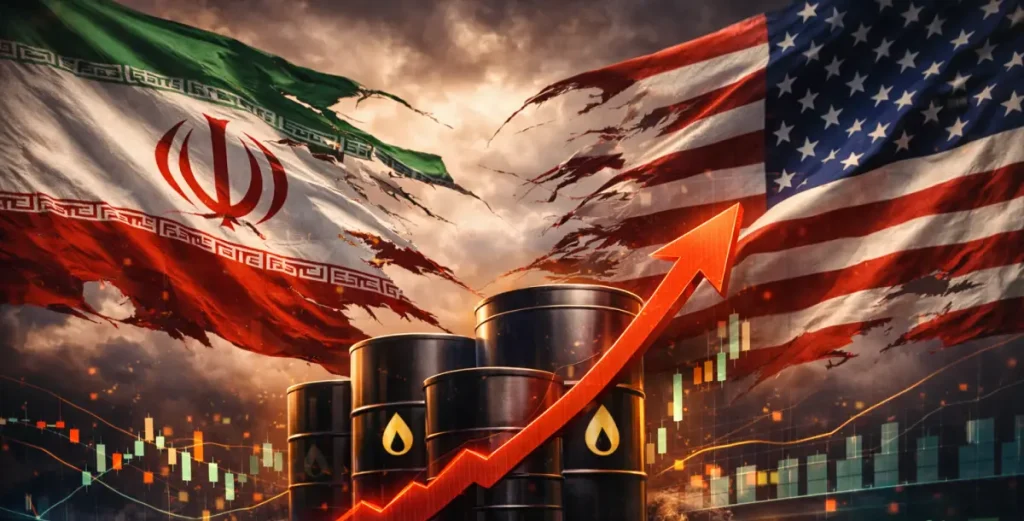
The events of March 2, 2026, have sent a shockwave through the global economy that traditional markets are struggling to absorb. With the sudden escalation of conflict in the Middle East and the death of Iran’s Supreme Leader, oil benchmarks are no longer just numbers on a screen—they have become a direct “volatility tax” on every household and business.
Since the onset of the latest friction, oil prices have spiked rapidly. As Brent crude blasts past the $80 threshold and eyes the century mark, economists like AMP’s Shane Oliver warn of a “high-risk case” where prices hit $150 per barrel. In this climate, the structural flaws of our legacy energy markets have been laid bare.
The Hormuz Chokepoint: A Single Point of Failure
The current crisis centers on the Strait of Hormuz, a narrow waterway responsible for 20% of the world’s oil and 25% of its liquefied natural gas (LNG). The impact of the conflict is two-fold:
- Physical Disruption: While the strait remains technically open, traffic has stalled as tankers sit idle, wary of retaliatory strikes.
- The Insurance Tax: Even if oil is physically available, shipping is effectively paralyzed by insurance premiums that have spiked over 50%.
For the average consumer, this translates to an immediate hit to the wallet—potentially adding $14 to weekly petrol bills and driving global inflation up by nearly a full percentage point.
The Anatomy of the Crisis: Where Legacy Finance Fails
In the traditional system, the price of oil isn’t just determined by the cost of a barrel; it is heavily weighted by counterparty risk and capital inefficiency.
When the Strait of Hormuz faces a “halt in traffic,” the following financial friction points occur:
- The Liquidity Trap: Crude oil is traded via complex futures contracts requiring significant margin. As volatility spikes, clearinghouses demand more collateral. This creates a “liquidity crunch” where participants are forced to liquidate positions, causing prices to swing wildly—often disconnected from the actual physical supply.
- The Cost of “Idle” Inventory: Currently, millions of barrels are sitting on tankers outside the Strait. In the legacy world, this is “dead capital.” Owners cannot borrow against it easily because the title of ownership is locked in slow-moving, paper-heavy systems.
- The Retail Disconnect: While institutional hedge funds use derivatives to protect themselves, the average consumer or small business owner is a “price taker.” They have no financial mechanism to offset the 40-cent-per-litre spike at the pump.
The Solution: Bringing the Oil Reserve Onchain
The current geopolitical instability is the strongest argument yet for the tokenization of oil. By converting physical crude oil or energy infrastructure into digital Real-World Assets (RWAs) on a blockchain, we can move from a fragile, centralized system to a resilient, transparent one.
How Tokenization Alleviates the Pressure
Tokenizing oil changes the fundamental physics of these financials. By digitizing the barrel, we inject elasticity and transparency into a market that is historically rigid and opaque.
- Democratizing the Hedge: Fractional Liquidity
In traditional markets, hedging against rising fuel costs requires complex futures accounts and high minimum capital. Tokenization breaks these barriers by allowing fractional ownership (down to 1/1,000th of a barrel).
The Market Impact: A logistics company or a private household can instantly acquire oil tokens as geopolitical tensions rise. As the cost of fuel rises at the pump, the value of their digital oil holdings increases proportionally, neutralizing the “war tax” on their operating budget without needing a Wall Street broker.
- T+0 Settlement: Eliminating “Geopolitical Lag”
Traditional energy markets rely on a multi-day settlement cycle (T+2 or T+3), which is an eternity when conflict moves at the speed of a news cycle. This delay forces banks to bake an “uncertainty premium” into every trade to cover potential price swings during the waiting period.
The Market Impact: Tokenized oil settles at the speed of the internet (T+0). By moving to instant, atomic settlement verified via Chainlink Proof of Reserve, the market eliminates counterparty risk. This keeps liquidity flowing even during extreme volatility.
- Enhancing Supply Chain Velocity via Provenance Data
In a crisis, the bureaucratic nightmare of re-routing physical contracts often causes more price spikes than the actual supply shortage.
The Market Impact: Tokenized assets carry onchain provenance data—a digital passport for every barrel. This allows buyers to instantly identify and pivot to supply from stable, non-conflict regions. By automating the verification of where the oil came from and who owns it, the global market can re-allocate resources in real-time, preventing localized bottlenecks from turning into global panics.
- Reducing the “Paper Oil” Friction
Much of the volatility in the oil market is driven by “paper oil”—financial derivatives that can become disconnected from physical reality during a crisis.
The Market Impact: Tokenization bridges the gap between the physical barrel and the digital trade. Because these tokens represent a direct claim on a real-world asset (RWA), they provide a more stable and transparent pricing mechanism. This reduces the reliance on over-leveraged clearinghouses and ensures that market liquidity is backed by actual energy reserves rather than just speculative bets.
From Volatility to Stability
The recent market panic serves as a stark reminder that our current global energy infrastructure is no longer equipped for the velocity of modern geopolitics. We are entering an era where market stability is the ultimate premium; through tokenization, we transform volatile commodities into liquid, stable digital assets that can withstand global shocks.
By migrating energy markets to the blockchain, we don’t just change how we trade oil—we democratize access to energy security. When the next “black swan” event hits, the world shouldn’t have to wait for the legacy system to catch up.
Future-Proof Your Energy Portfolio with ChainUp
The transition from physical barrels to digital tokens requires a partner who understands institutional-grade infrastructure. Whether you are looking to unlock liquidity from idle inventory or launch a fractionalized investment platform, ChainUp’s Asset Tokenization Solution provides the end-to-end framework to bring your energy ventures onchain.
From secure custody and automated compliance to seamless integration with the DeFi ecosystem, we provide the tools to turn global market volatility into a sustainable strategic advantage.
Ready to lead the digital revolution in energy?
🚀 Explore ChainUp Tokenization Solution and discover how we can support your journey in the tokenization of oil and other real-world assets.