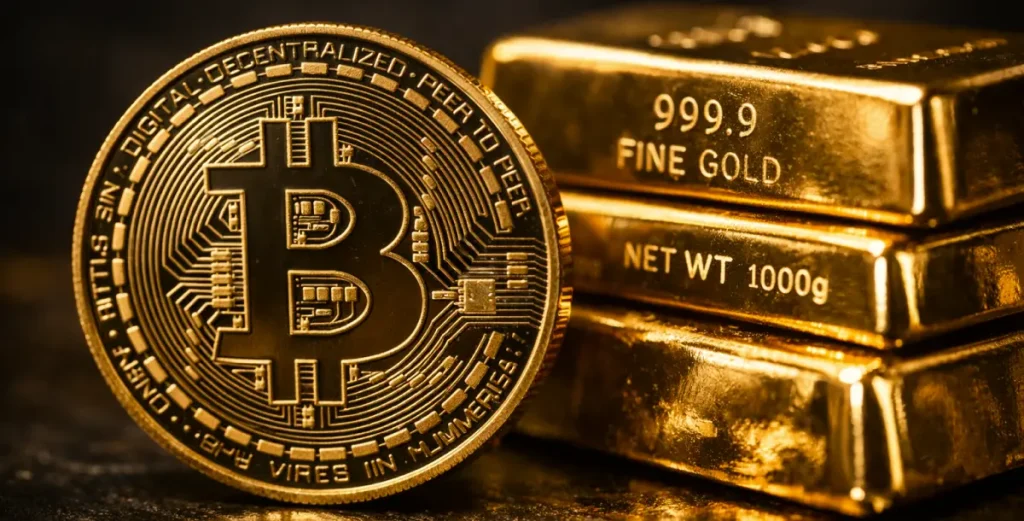
Is the “Digital Gold” narrative dead, or is it finally coming of age? As of late January 2026, a historic divide has opened in global markets. While Gold (XAU) has rocketed to a breathtaking $5,300 per ounce, shattering records daily, Bitcoin (BTC) is stuck in a consolidation phase near $88,000, roughly 30% below its October 2025 peak of $126,000.
To the casual observer, this looks like a defeat for crypto. To the institutional strategist, however, we are witnessing a “Great Decoupling”, a moment these two assets have finally distinguished their roles: Gold as the geopolitical shock absorber and Bitcoin as the global liquidity sponge.
The End of the “Mirror Trade”
For years, investors assumed Gold and Bitcoin were twin assets that should move in lockstep against a weakening dollar. 2026 has definitively broken that correlation, revealing two distinct defensive profiles.
- Gold as the “Bunker”: With gold hitting $5,300, it is clearly the primary beneficiary of geopolitical “flight-to-safety.” Central banks have doubled their purchases, seeking a physical, non-sovereign reserve that cannot be “switched off” by software updates or sanctions.
- Bitcoin as the “Liquidity Gauge”: Bitcoin has matured into a barometer for global M2 money supply and risk appetite. While it may not be acting as a “fear hedge” today, it is acting as a high-performance tech-proxy. Analysis from VanEck and JPMorgan confirms that Bitcoin now thrives when liquidity is expanding, rather than just when fear is rising.
Capital Mechanics: The Liquidity “Gravity Wall”
Even prominent Bitcoin bulls acknowledge the current “Gold Fever”. Fundstrat’s Tom Lee notes that capital has not vanished; it has simply parked in the “financial bunker.”
- Institutional Risk Budgets: Lee points out that big institutions often choose one dominant trade at a time. Currently, that trade is gold. This “sucks the oxygen out of the room” for Bitcoin and Ethereum, leaving them to consolidate sideways.
- The Cycle Rotation: Gold ETFs pulled in a staggering $10 billion in the first half of 2025. However, history suggests that when precious metals peak and the trade becomes overcrowded, capital often rotates back into high-upside assets. With Bitcoin and Ethereum firmly established in regulated ETFs, that rotation could be more explosive than ever before.
Technical Headwinds and the Perception of Trust
Why is gold outshining Bitcoin during this period of fiscal volatility and a 77% chance of a U.S. government shutdown? Analysts like Gabe Selby (CF Benchmarks) and Ed Yardeni point to a crisis of technical and political trust:
- Institutional Flight to Physical: Central banks have doubled their annual gold purchases. Following the 2022 seizure of Russian assets, sovereign nations are seeking “non-sovereign” reserves that can’t be “switched off” by a foreign power or a software update.
- The Quantum Threat: A new technical shadow has entered the chat. Coinbase and BlackRock have warned that nearly one-third (32.7%) of all Bitcoin—roughly 6.5 million BTC—is vulnerable to “long-range attacks” from emerging quantum computers. Gold, stored in physical vaults, requires no protection against Shor’s or Grover’s algorithms.
- Competition vs. Scarcity: Bloomberg’s Mike McGlone argues that Bitcoin’s scarcity narrative is diluted by the 20,000+ other digital assets that can be “created with lines of code.” Gold’s only true rivals remain silver, platinum, and palladium.
While Bitcoin offers digital portability, gold is currently winning the trust war by offering a physical, “un-hackable” refuge that lacks the software vulnerabilities and market dilution currently haunting the crypto space.
From Speculation to Infrastructure: The 2026 Pivot
While price volatility captures headlines, a more profound shift is occurring: the transition of digital assets from speculative trades into practical financial infrastructure.
- The DATCO Evolution: Digital Asset Treasury Companies (DATCOs) are pivoting away from simply “HODLing” tokens. According to B. Riley, 2026 marks the year these firms become operating businesses focused on institutional tokenization and recurring revenue from staking.
- Systemic Integration: In a major win for the sector, MSCI recently reversed a proposal to exclude DATCOs from global equity indexes. This decision stabilizes passive fund flows for companies like MicroStrategy (MSTR), allowing them to be viewed as operating companies rather than mere passive investment vehicles.
- Utility-Driven Revenue: Analysts highlight firms like BitMine Immersion Technologies (BMNR), which are expanding infrastructure to generate revenue from staking rather than just price appreciation. This shift suggests that even if Bitcoin’s price lags behind gold, the underlying ecosystem is becoming a permanent fixture of global finance.
Infrastructure as the Modern Anchor
The 2026 decoupling represents a milestone in market maturity. Gold remains the 2,000-year-old choice for wealth preservation during fiscal storms. Simultaneously, blockchain is cementing itself as the infrastructure layer for the next decade of finance.
The focus has shifted from “What is it worth?” to “What can it do?” If you’re looking for an anchor, Gold is the choice. But if you’re looking to lead the next decade of finance, you must look toward the technology powering the rotation: blockchain infrastructure.
ChainUp: Powering the Future of Digital Assets
As a global leader in end-to-end digital asset technology, ChainUp provides the institutional-grade infrastructure that powers this era of utility.
- Institutional Custody & Security: Our White-Label MPC Wallet provides the military-grade security and KYT (Know-Your-Transaction) compliance necessary for institutional-grade asset management.
- Liquidity & Exchange Solutions: We power global markets through our white-label exchange systems and Liquidity Technology, ensuring that digital assets remain liquid and accessible 24/7.
- Next-Generation Asset Infrastructure: Beyond our White-Label Tokenization Platform, we support the wider Web3 ecosystem through industrial-grade staking, validator operations, and robust blockchain APIs that allow businesses to generate recurring value.
Ready to transition from a passive holder to an infrastructure leader? Explore ChainUp’s Full Ecosystem of Infrastructure Solutions Today.