Cryptocurrency is a type of digital money that uses computer networks and cryptographic techniques to operate securely, independently, and transparently. Unlike traditional money issued by governments, cryptocurrencies are not tied to any single institution or central bank. They exist purely in digital form and are typically not issued or controlled by any government.
This means users can send, receive, and store value without relying on banks or payment processors. Instead, transactions are recorded on a blockchain—a public, tamper-proof digital ledger that is accessible to anyone and maintained by a decentralised network of computers (called nodes).
The first and most widely known cryptocurrency is Bitcoin, launched in 2009. It was originally created as a response to the global financial crisis to offer an alternative to centralised monetary systems. Since then, thousands of cryptocurrencies have emerged, including:
- Ethereum – known for enabling smart contracts and decentralised apps (dApps)
- Solana – built for speed and low-cost transactions
- Ripple (XRP) – designed for real-time cross-border payments, often used by banks
Key Features of Cryptocurrency
So, what makes cryptocurrency different from the money you use every day? Below are some of the defining traits that separate cryptocurrency from traditional money:
| Feature | Description |
| Digital | Cryptocurrencies exist entirely online. They have no physical equivalent (no coins or bills). All ownership, balances, and transactions are tracked digitally via software. You store them in digital wallets, not bank vaults. |
| Decentralized | Unlike traditional financial systems, which are controlled by central banks or institutions, most cryptocurrencies are built on decentralized networks. This means that thousands of independent computers around the world validate and process transactions, removing the need for a central authority. |
| Encrypted | Cryptocurrencies use advanced cryptographic algorithms to secure transactions and protect user data. This encryption ensures that only the rightful owner can access and move funds, preventing tampering, counterfeiting, and fraud. |
| Transparent | Most cryptocurrencies operate on public blockchains, where every transaction is recorded and viewable by anyone. This allows full transparency—anyone can verify transaction history while identities remain pseudonymous. This is why blockchains are often called “trustless” systems—trust is replaced by public verification. |
| Immutable | Once a transaction is added to the blockchain, it cannot be altered or deleted. This immutability guarantees that records are permanent and unchangeable. It prevents manipulation or retroactive edits—making cryptocurrency a reliable source of financial truth. |
How Does Cryptocurrency Work?
While cryptocurrency might sound complicated, the core idea is simple: it’s a way to send, receive, and store value digitally—without needing banks or intermediaries. But under the hood, it’s powered by a set of technologies that make it secure, transparent, and efficient.
Blockchain Technology
At the heart of most cryptocurrencies is a technology called the blockchain—a type of digital ledger or database. But unlike a regular ledger kept by a bank, this one is public, distributed, and tamper-resistant.
- A blockchain records every transaction ever made in the network.
- Each block contains a batch of transactions, and new blocks are added in sequence—chronologically and permanently.
- These blocks are linked together like a chain (hence the name), and once added, a block cannot be changed.
- The blockchain is stored across thousands of computers (or “nodes”), so no single entity controls it.
This allows anyone to verify the history of transactions, building trust without a central authority.
Because the ledger is immutable and transparent, it enforces digital scarcity. Issuance rules are defined in code, transactions can’t be forged or rewritten, and anyone can audit the total supply. These traits allow a cryptoasset to act as a store of value.
And because thousands of independent nodes validate and record transactions by consensus (not a single operator), control is distributed end-to-end, making the cash system decentralized, censorship-resistant, and resilient to single-point failure.
Mining and Validation
Before a transaction is added to the blockchain, it must be validated. This happens in two main ways:
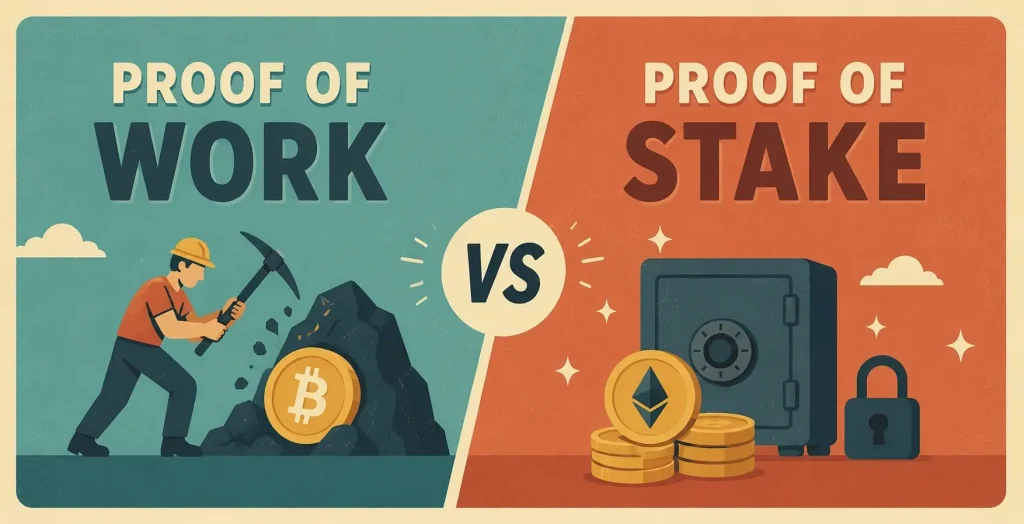
Proof of Work (PoW) – Mining
Used by Bitcoin and similar coins:
- Specialized computers compete to solve complex mathematical puzzles.
- The first to solve it gets to add the next block and earn a reward—this is called mining.
- It’s energy-intensive but highly secure.
Proof of Stake (PoS) – Validation
Used by Ethereum and newer coins:
- Validators are chosen to confirm transactions based on how much cryptocurrency they hold and “stake.”
- This method is more energy-efficient and faster than mining.
Delegated Proof of Stake (DPoS)
Used by EOS, TRON, and similar networks:
- Token holders vote to elect a limited set of validators (“delegates”) who produce blocks.
- Delivers high throughput and low fees, but increases governance concentration and depends on voter participation.
Proof of Authority (PoA)
Used by VeChain and some Ethereum sidechains/private networks:
- Pre-approved, identity-verified validators sign blocks.
- Offers low latency and predictable finality—well-suited to permissioned/enterprise deployments.
BFT-style
Used by many Cosmos chains and newer L1s:
- A known validator set reaches agreement via voting rounds and quorum thresholds.
- Provides fast, deterministic finality, but depends on validator availability and network reliability.
Proof of History (PoH)
Used by Solana:
- A verifiable cryptographic clock orders events before consensus.
- Combined with PoS for leader rotation, enabling high throughput and low latency.
Proof of Space/Capacity (and Time)
Used by Chia:
- Participants commit disk space as the scarce resource, “farming” to win block rights.
- Paired with a time mechanism to prevent grinding, significantly lowering energy use versus PoW.
Crypto Wallets
To use cryptocurrency, you need a wallet—a tool that lets you store, send, and receive digital coins. There are two main types:
| Wallet Type | Description |
| Hot Wallets | Software-based and connected to the internet (e.g. mobile apps, desktop wallets, browser extensions). Easy to use, but more vulnerable to hacks. |
| Cold Wallets | Hardware devices or paper wallets stored offline. Much more secure for large amounts, but less convenient for frequent use. |
Every wallet has:
- A public address: Like a bank account number—you can share it to receive crypto.
- A private key: Like your PIN or password—used to access your funds. If lost, you lose access permanently.
What Can You Do With Cryptocurrency?
All of these use cases flow from a simple foundation: blockchains create digital scarcity and verifiable ownership. Because supply rules are enforced in code and every transfer is recorded immutably, a cryptoasset can function as a store of value—something others will accept and hold.
The same mechanism extends beyond coins to NFTs and tokenized assets (from art and game items to tickets, loyalty points, and real-world assets). Once value and ownership are provable on-chain, they become portable, programmable, and collateralizable, which unlocks payments, investing, commerce, and DeFi.
1. Send and Receive Money
Borderless transfers work because you control a bearer-style asset with final settlement on-chain. No bank needs to vouch for you; your wallet signature proves ownership, and the network confirms the transfer. That same property lets creators or contractors get paid directly and instantly, even across jurisdictions.
2. Invest for Potential Growth
The investment thesis rests on scarcity and predictable issuance. If a network’s supply and security are credible, people are willing to hold the asset over time—similar to gold’s role. They anticipate either adoption-driven appreciation or diversification benefits. NFTs inherit this too: unique tokens can hold cultural, utility, or cash-flow value that markets can price and trade.
3. Buy Goods and Services
Merchants accept cryptocurrency when they trust its value will persist long enough to convert or hold. On-chain ownership makes it easy to settle payments globally, and token formats allow receipts, discounts, or access passes to be embedded directly into the transaction (often as NFTs or token-gated perks).
4. Access Decentralized Finance (DeFi)
DeFi treats on-chain assets as programmable collateral. Because ownership is provable, you can lend, borrow, and trade directly from your wallet, with smart contracts enforcing terms. Coins, stablecoins, and even NFTs or tokenized real-world assets can be posted as collateral, earn yields, or be fractionally traded—extending the store-of-value idea into a composable financial stack.
Popular Cryptocurrencies You Should Know
There are thousands of cryptocurrencies in circulation today, but only a handful dominate in terms of usage, credibility, and real-world application. Whether you’re looking to invest, explore decentralized finance, or simply understand the ecosystem, here are some of the most notable cryptocurrencies and what makes them stand out:
| Cryptocurrency | Use Case | Notable Feature |
| Bitcoin (BTC) | Digital store of value | The original cryptocurrency, known for its scarcity and security. Often referred to as “digital gold.” |
| Ethereum (ETH) | Smart contracts and DeFi | Built as a programmable blockchain where developers can create decentralised apps (dApps) and smart contracts. It powers the majority of DeFi protocols and NFTs. |
| Tether (USDT) | Stable digital dollar | A stablecoin pegged to the US dollar. Used to avoid volatility in crypto markets while maintaining blockchain benefits. |
| Solana (SOL) | High-speed blockchain apps | Known for low transaction costs and fast processing. Popular with developers building DeFi apps and NFT platforms. |
| Ripple (XRP) | Cross-border payments | Built for institutional use, especially by banks and remittance companies. Designed to move money across borders quickly and cheaply. |
| Chainlink (LINK) | Oracles & data feeds | Pays decentralized oracle nodes to deliver off-chain data to smart contracts. |
| Filecoin (FIL) | Decentralized storage | Token used to buy storage and as collateral by storage providers. |
| The Graph (GRT) | Indexing & queries | Staked by indexers who serve blockchain data; consumers pay per query. |
| Uniswap (UNI) | DEX governance | Governs the leading AMM DEX; influences protocol fees and upgrades. |
| Aave (AAVE) | Lending & borrowing | Governs the lending protocol; staking backs a safety module against shortfalls. |
| DAI (MakerDAO) | Decentralized stablecoin | Crypto-collateralized dollar stablecoin governed by MKR holders. |
| Lido stETH (stETH) | Liquid staking receipt | Tokenized staked ETH that accrues rewards and remains usable in DeFi. |
| Render (RNDR) | Distributed GPU compute | Pays node operators for rendering/AI jobs; ties token to real compute. |
| Helium (HNT) | Wireless IoT network | Incentivizes community-run hotspots; usage burns HNT into Data Credits. |
These coins serve different purposes—some are used for trading and investing, others power blockchain platforms, and a few act as stable currency alternatives.
Is Cryptocurrency Safe?
The technology behind cryptocurrency is secure—blockchain networks use advanced cryptography, decentralization, and public transparency to prevent fraud and tampering.
But owning and using cryptocurrency still comes with real-world risks, especially for beginners. Here’s what to watch out for:
-
Volatility
Crypto prices can fluctuate wildly. A coin worth $50,000 today might drop to $30,000 tomorrow. High gains are possible, but so are big losses.
-
Scams and Fraud
The crypto space is full of fraudulent schemes, including:
- Rug pulls (fake projects that vanish after collecting money)
- Phishing attacks (fake login pages or support agents)
- Impersonators offering fake giveaways or investment returns
-
Developing Regulation
Crypto laws vary by country and are still evolving. Some governments are embracing it, others are restricting or banning it. This legal uncertainty can affect exchanges, asset values, or even your ability to use crypto.
-
Irreversible Transactions
Unlike banks or credit cards, there are no refunds in cryptocurrency. If you send funds to the wrong address—or fall for a scam—they’re gone for good.
How to Stay Safe
To protect yourself while using cryptocurrency:
| Safety Tip | Why It Matters |
| Use trusted platforms | Only buy and trade on reputable exchanges (e.g., Coins.ph, Binance, PDAX). Avoid random links. |
| Enable 2FA | Two-factor authentication helps prevent unauthorized access to your accounts. |
| Use hardware wallets for large amounts | Cold wallets (offline storage) keep your crypto safe from online hacks. Ideal for long-term holders. |
| Stay informed on regulations | Monitor local and international crypto policies to avoid legal issues or sudden service disruptions. |
Crypto in 2025: Market Size, Users, and Milestones
Over the past few cycles, a few events have pulled cryptocurrency into the financial mainstream. Bitcoin’s fourth halving on April 20, 2024, cut new BTC issuance from 6.25 to 3.125 BTC per block, reinforcing programmed scarcity that underpins the “digital gold” narrative.
In January–December 2024, the launch and success in its first year of U.S. spot Bitcoin ETFs unlocked traditional brokerage access and drew tens of billions in net inflows; by late 2024 they were among the most successful ETF launches on record.
In July 2024, the SEC approved spot Ether ETFs, extending regulated exposure beyond Bitcoin and further integrating crypto with capital markets.
As of September 2025, the total crypto market capitalization sits around $3.8–$3.9 trillion, depending on the data source and intraday moves—an order of magnitude that reflects both institutional participation and broader retail adoption. Bitcoin still commands a majority share of value (“dominance”), with stablecoins also representing a substantial slice of the market.
How Many People Use Crypto?
User counts vary by methodology, but the direction is clear. A widely cited payments report estimated over 560 million crypto owners in 2024 (an estimated 6.8% global penetration). Independent trackers suggest the total approached around 600 million by mid-2025, alongside steady growth in merchants accepting crypto. Different studies still disagree (some lower, some higher), so it’s best to view these as ranges rather than a single definitive number.
Everyday usage has broadened beyond trading. Payments and cross-border transfers continue to grow as more merchants and platforms accept digital assets.
Investing has expanded from direct ownership to regulated ETFs for BTC and ETH, opening access through traditional brokerages. DeFi lets users lend, borrow, and trade directly from wallets, while stablecoins provide lower-volatility settlement on-chain and now account for a material share of market value.
Extension Products and the Broader Stack
The market now includes spot ETFs, layer-2 scaling, liquid staking, oracles, and a growing set of real-world asset (RWA) tokens—all sitting alongside core primitives like wallets and exchanges. Institutions increasingly favor hybrid models that pair exchange liquidity with custodian-held assets, while research indicates individuals still hold a majority of Bitcoin—even as funds and ETFs gain share.
By 2025, cryptocurrency is a multi-trillion-dollar market with hundreds of millions of users. The shift from speculative curiosity to globally accessible, programmable finance is well underway—driven by hardening monetary design (e.g., the halving), regulated access (ETFs), and a layered stack of products that extend far beyond simple coin transfers.
Final Thoughts
Cryptocurrency isn’t just a trend—it’s a new way of thinking about money. It gives individuals the ability to transact, invest, and participate in financial systems without depending on traditional banks, governments, or intermediaries. That’s powerful—but it also comes with responsibilities.
While the technology is built on transparency and security, it’s not foolproof. Success in crypto—whether you’re investing, trading, or simply exploring—relies on doing your homework. You’ll need to:
- Understand the tools (wallets, exchanges, blockchains)
- Stay updated on legal developments and security practices
- Make informed decisions based on risk, not hype
Cryptocurrency is not a get-rich-quick scheme or a guaranteed investment. It’s a tool—and like any tool, how you use it determines the outcome.
If you’re curious, cautious, and committed to learning, you’re already ahead of the curve in today’s rapidly digitizing financial world.
If you’re looking to build your own crypto platform or integrate digital assets into your services, ChainUp can help.
With end-to-end blockchain infrastructure—from crypto exchanges and wallets to liquidity solutions and compliance tools—ChainUp powers businesses across the globe to confidently enter the digital asset space.